

Is Well Water Safe to Drink? What to Test First, and Why Yellow, Rusty Water Happens
Is well water safe to drink? The answer is: yes, when test results meet drinking water quality criteria. Every groundwater well is different, depending on the soil and rock layers the water flows through. Water that looks clear may contain arsenic or germs you cannot see. Well water that turns yellow or leaves rust stains is mostly caused by dissolved iron and manganese. This article explains what to test for, which criteria to compare against, and what yellow water can and cannot tell you.
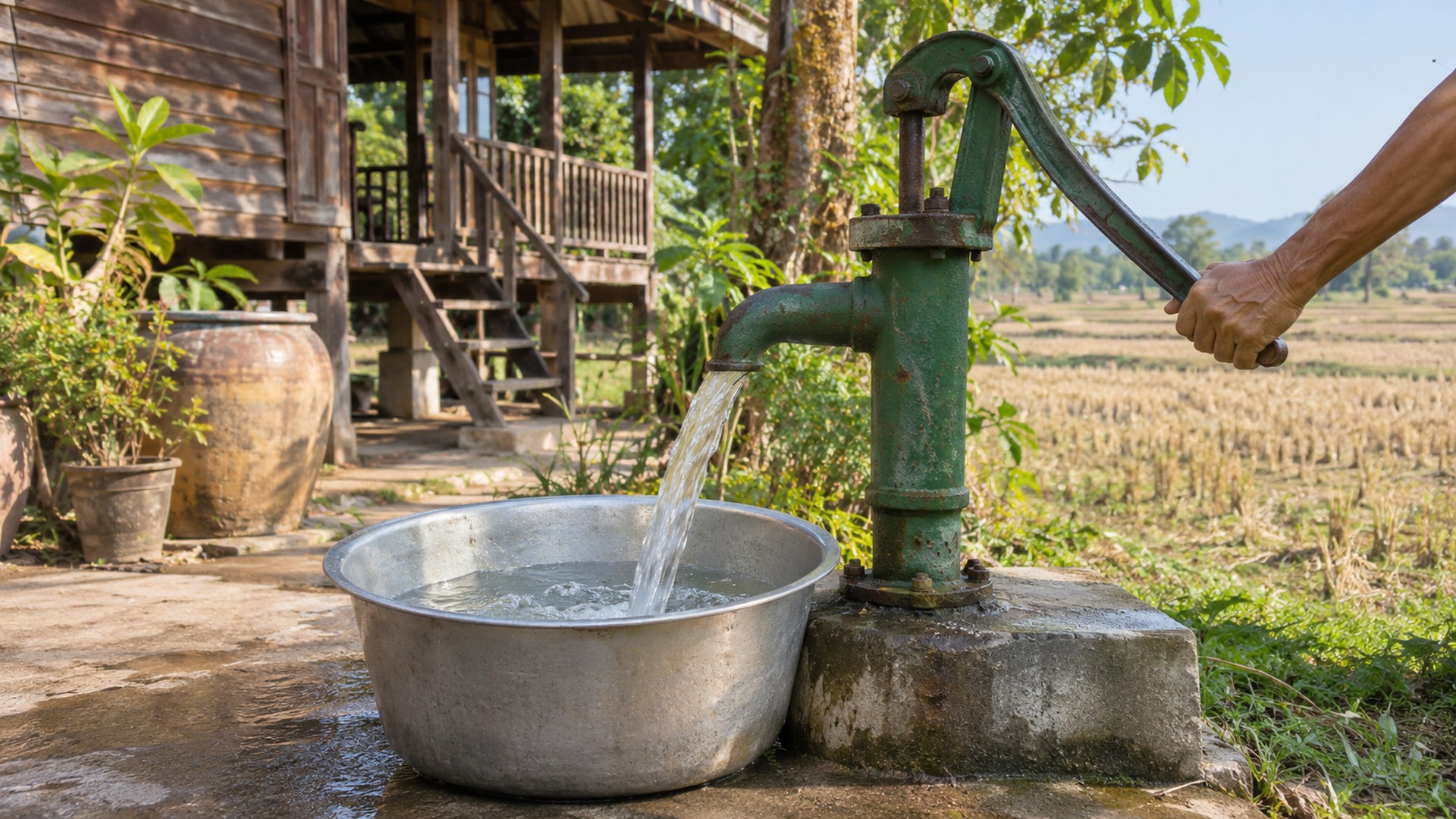
What is groundwater, and how is it different from a shallow well?
The manual of Thailand's Department of Local Administration (May 2022) explains that groundwater comes from rain or surface water that seeps through soil and rock layers and collects in basins underground. People bring it up by drilling groundwater wells. The same manual places shallow wells in the surface water group, together with streams, swamps, canals and ponds.
This difference affects water quality. Shallow wells take in water that has only just seeped down from the surface, so they are more easily contaminated by what is on the ground. Research in farming areas of Ubon Ratchathani Province, northeast Thailand, found that people who drank shallow groundwater had higher arsenic in their hair and nails than people who drank tap water produced from deep wells and treated. Deep wells are not always safe either, because the water may dissolve minerals from deep rock layers. In both cases, you have to look at the test results.
Which criteria decide whether well water is safe to drink?
There are 2 sets of documents for groundwater used for consumption in Thailand, and they apply at different stages.
- The standards for groundwater fit for consumption are issued under Thailand's groundwater law. The Department of Local Administration manual refers to the Ministry of Natural Resources and Environment Notification on technical criteria and measures for public health protection and prevention of environmental pollution (2008). These standards are used to judge groundwater quality at the well, for example when a well is going to be used as the raw water source for a village water supply, in which case a water sample must be sent for analysis before use.
- Thailand's Department of Health criteria for drinkable tap water (2020) are used to judge the water people actually drink. The Department of Local Administration requires water that village water supplies produce from groundwater to meet these criteria.
This article has not yet reviewed the table of values in the 2008 groundwater standards, so it does not quote numbers from that notification. It uses the Department of Health criteria for drinkable tap water (2020) for comparison, for 3 reasons:
- "Is it safe to drink?" is a question about water that goes into your mouth, which is the scope of drinking water criteria.
- The 2020 criteria cover physical, chemical and microbiological aspects, and the Department of Health states that they refer to World Health Organization guidelines.
- The arsenic value in these criteria is 0.01 mg/L, the same as the World Health Organization guideline value.
| Parameter | Department of Health criteria for drinkable tap water, 2020 (not more than) |
|---|---|
| Turbidity | 5 NTU (nephelometric turbidity units) |
| Iron | 0.3 mg/L |
| Manganese | 0.3 mg/L |
| Fluoride | 0.7 mg/L |
| Arsenic | 0.01 mg/L (10 parts per billion, or ppb) |
| Lead | 0.01 mg/L |
| Cadmium | 0.003 mg/L |
| Mercury | 0.001 mg/L |
| Coliform bacteria and E. coli | Must not be detected |
If you are not used to these units, see how to convert mg/L to ppm and ppb in What are ppm and ppb? and read the full criteria in Thailand's tap water standard (Department of Health, 2020)
Well water testing: what to check before you drink
Each well needs different checks, but in general testing should cover these groups:
| Group | Example parameters | Why test |
|---|---|---|
| Germs | Coliform bacteria, E. coli | A cracked wellhead or well platform can let surface water run into the well; germs cannot be seen |
| Physical | Turbidity, color, pH | Shows the basic condition of the water and whether it needs filtering or adjusting before use |
| Iron and manganese | Iron, manganese | Cause yellow water, rust stains and black stains |
| Dissolved minerals | Hardness, total dissolved solids, chloride, sulfate | Affect taste, scale and the choice of filtration |
| Fluoride | Fluoride | Some community water sources are high in fluoride, which can cause dental fluorosis in children |
| Arsenic and heavy metals | Arsenic, lead, cadmium, mercury | No color, no smell and no taste; you only know by testing |
Clear does not mean safe. Looking, smelling and tasting only tell you about physical aspects such as color, odor and turbidity. Arsenic and heavy metals can only be found by testing.
Where to get well water tested
- Village water supply wells: ask the local government or the system operator for the latest test results. The Department of Local Administration manual requires local governments to send village tap water samples for testing at least once a year. Read more about these systems in What is a village water supply?
- Wells of a household or a group of households: send a sample to a laboratory, or ask local agencies such as the regional Groundwater Resources Office, the regional Health Center or the Provincial Public Health Office.
- If you want an initial screening first: field test kits can quickly show which wells should be sent to a laboratory for confirmation. See how the methods differ in Water quality testing methods
Why is well water yellow or rusty?
Well water that comes up clear but turns yellow, orange or reddish-brown after standing for a while is a sign of iron in the water. The World Health Organization guidelines for drinking-water quality (chapter 10, on taste, odor and appearance) explain:
- Groundwater without oxygen can contain several mg/L of soluble iron (ferrous iron) while still looking clear when pumped from the well.
- When the water is exposed to air, the iron turns into ferric iron, making the water reddish-brown.
- Iron above 0.3 mg/L stains laundry and plumbing fixtures.
- Iron also helps "iron bacteria" grow, which leave slime in pipes and can cause rust-colored deposits in tanks and pipes.
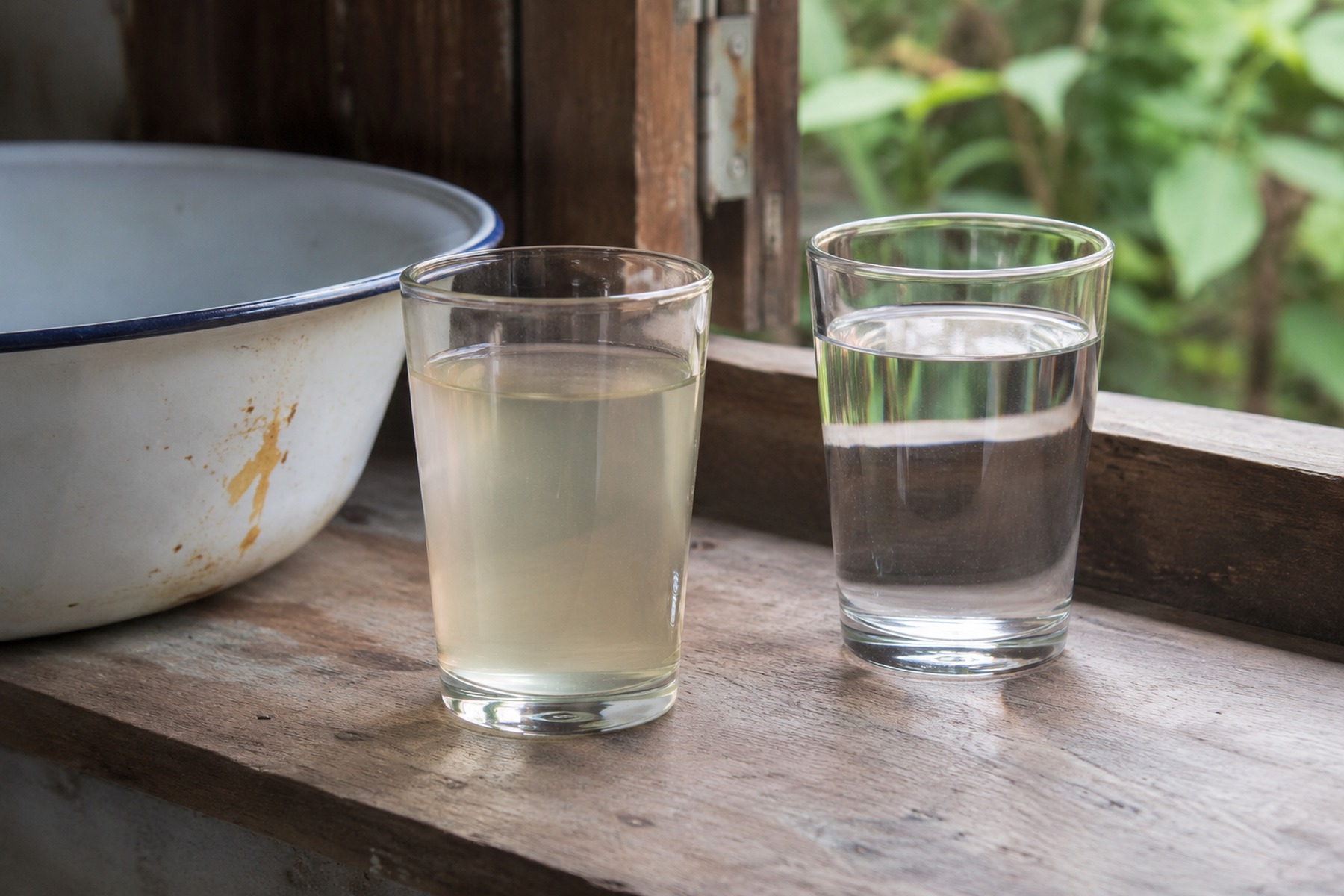
Manganese causes similar problems. The World Health Organization states that as little as 0.02 mg/L of manganese, in the form of insoluble oxides, can discolor water and stain laundry, and it can build up in pipes and come loose as black sediment. But dissolved manganese has no color, so colorless water does not mean there is no manganese.
Is yellow well water safe to drink?
The World Health Organization has not set a health-based guideline value for iron, because the main problems are color, taste and stains. For manganese, the World Health Organization has a health-based guideline value of 0.08 mg/L and recommends considering both acceptability and health when setting standards.
In practice, yellow water is a sign that the well should be tested, because yellow color only tells you there is iron. It cannot tell you whether other substances are present or absent. Research in the Chiang Mai Basin, northern Thailand, published in 2026 found that in groundwater layers without oxygen, iron, manganese and arsenic can occur together. While you wait for test results, use water from a tested source for drinking and cooking.
Rotten-egg smell and scale
- A rotten-egg smell comes from hydrogen sulfide gas. The World Health Organization explains that this smell is found in some groundwater and is produced by bacteria that convert sulfate when the water lacks oxygen. The smell is easy to notice, and people are unlikely to take in a harmful amount from drinking water, but the World Health Organization considers it a sign that needs to be fixed right away.
- White scale comes from hardness (calcium and magnesium). Water harder than about 200 mg/L can leave scale in pipes, tanks and kettles. The World Health Organization has not set a health-based value for hardness.
How to reduce iron and manganese
The principle is to turn iron and manganese into particles first, then filter them out. The World Health Organization states that manganese can be removed in several ways, such as oxidation followed by filtration. Many village water supplies that use groundwater therefore have an aeration step followed by filter tanks using filter sand, anthracite or manganese greensand, as shown in the Department of Health assessment form for village water production systems.
One thing to know: boiling does not remove metals. Boiling kills germs, but it does not remove arsenic or heavy metals. Read more in Is tap water safe to drink?
Groundwater arsenic: should you be concerned?
The World Health Organization states that arsenic-contaminated groundwater is the greatest public health threat from this substance, whether through drinking, through crops irrigated with that water, or through food cooked in it. Arsenic is found throughout the Earth's crust, so groundwater can be high in arsenic in areas with certain minerals, or in water layers without oxygen where arsenic is released from sediment into the water.
In Thailand, a well-known example is Ron Phibun District in Nakhon Si Thammarat Province, southern Thailand, a former tin mining area. Research from 1996 found that shallow groundwater had higher arsenic than water in the limestone layer below, and that the main measure that helped the community was switching to drinking water from safe sources. In 2026 research in the Chiang Mai Basin, the researchers explained that arsenic in some groundwater wells comes from natural processes in water layers without oxygen, and they proposed monitoring deep wells as well.
Exposure to arsenic does not mean you will get sick. Health effects depend on the amount and the length of exposure. Drinking water high in arsenic continuously over a long time increases the risk of skin disease and some cancers. Read more about arsenic in What is arsenic?
What to do if well water test results exceed the criteria
- Stop using the water for drinking and cooking for now, and use water from a tested source.
- Send a sample to a laboratory for confirmation if the result came from a field test kit.
- If it is a village water supply well, tell the local government or the system operator so they can look at improving the system.
- If you have been drinking the water for a long time, or have unusual symptoms, consult your subdistrict health promoting hospital or a nearby hospital.
- If you plan to install a filter, choose a method that works for the substances actually found, and test the water again after installation.
These steps are synthesized from advice by Thailand's Ministry of Public Health and drinking water agencies abroad. If your local agency has specific advice, follow your local agency first.
Keeping a groundwater well clean
- A strong well platform: the Department of Health assessment form for village water production systems checks that the well platform is not cracked, leaking or sinking, so that surface water cannot run into the well.
- A clean area around the well: no weeds, used filter media or other items piled around the well.
- Regular retesting: groundwater quality can change with the seasons and with pumping. Village water supplies should test on the schedule set in the manual, and household wells should be tested when first used and whenever the color, smell or taste changes.
How M-Sense can help
M-Sense is a portable heavy metal test kit for water from the National Nanotechnology Center (NANOTEC), part of Thailand's National Science and Technology Development Agency (NSTDA). It tests arsenic, lead, cadmium and mercury in about 5 minutes, reports results as numbers from ppb to ppm, and can be used with groundwater.
For groundwater work, M-Sense helps agencies quickly screen many wells in an area on site, then choose which wells should be sent to a laboratory for confirmation. Results that exceed the criteria should be confirmed with standard laboratory methods. M-Sense does not test iron, manganese, fluoride or germs, so it is used alongside other tests under the drinking water criteria. See what it detects on the What it detects and the limits page.
Frequently asked questions
Is well water safe to drink? Yes, when test results meet drinking water quality criteria, such as Thailand's Department of Health criteria for drinkable tap water (2020). Every well is different, so you need the test results for that well.
What are groundwater standards? In Thailand, these are the standards for groundwater fit for consumption, issued under the groundwater law and used to judge water quality at the well. Water that a village water supply produces and supplies for drinking must meet the Department of Health criteria for drinkable tap water (2020).
What makes well water yellow? Mostly dissolved iron, which turns reddish-brown when it meets air. Manganese can also discolor water and cause black stains. Test the water to know the exact levels.
Is iron in water dangerous? The World Health Organization has not set a health-based value for iron; the main problems are color, taste and stains. However, the Department of Health criteria for drinkable tap water set iron at not more than 0.3 mg/L, and yellow water cannot tell you whether other substances are present.
Can I drink well water after boiling it? Boiling kills germs, but it does not remove arsenic, heavy metals, iron or manganese. If you do not know the test results, boiling is not enough.
What causes a rotten-egg smell in well water? Hydrogen sulfide gas, produced by bacteria in water without oxygen. Tell the system operator or look for a fix, such as aeration or filtration.
Want to screen for arsenic and heavy metals in your area's groundwater?
Ask NANOTEC · What it detects and the limits · Field use
References
- Department of Local Administration, Ministry of Interior, Thailand. Manual on criteria and quality standards for village water supply systems of local government organizations, May 2022.
- Ministry of Natural Resources and Environment Notification on technical criteria and measures for public health protection and prevention of environmental pollution, 2008 (as cited in the Department of Local Administration manual).
- Division of Public Health Laboratory, Department of Health. Department of Health criteria for drinkable tap water, 2020 (document SD-RLDC-006, effective 28 April 2023).
- Bureau of Food and Water Sanitation, Department of Health. (Draft) Assessment form for village water production systems (groundwater sources), 2026.
- World Health Organization. Guidelines for drinking-water quality, 4th edition incorporating the first, second and third addenda, Chapter 10: Acceptability aspects: taste, odour and appearance.
- World Health Organization. Arsenic (fact sheet), 7 December 2022.
- World Health Organization. Guidelines for drinking-water quality, 4th edition incorporating the first and second addenda, 2022 (chemical fact sheet: arsenic).
- Williams M, et al. Environmental Geology, 1996 (study of arsenic in surface water and groundwater, Ron Phibun District, Nakhon Si Thammarat Province).
- Chongsuvivatwong V, et al. Follow up of water use in a tin mining area affected with arsenic poisoning. Southeast Asian J Trop Med Public Health 2000;31(4):769-74.
- Wongsasuluk P, et al. Environmental Research, 2018 (use of hair and nails to monitor heavy metals from groundwater in farming areas) and Human biomarkers associated with low concentrations of arsenic and lead in groundwater in agricultural areas of Thailand. Scientific Reports, 2021.
- Benjakul et al. Redox controls on dissolved metal distribution and screening-level health risks in groundwater of the Chiang Mai Basin, Northern Thailand. Toxics, 2026.
- Hfocus. Ministry of Public Health warns people in risk areas to avoid arsenic-contaminated water, 11 November 2026.
- National Nanotechnology Center. Portable electrochemical test kit for heavy metal contamination in water (M-Sense).