

Is Tap Water Safe to Drink? What to Check, and What Boiling Can and Cannot Do
Is tap water safe to drink? Yes, if the water meets Thailand's Department of Health criteria for drinkable tap water (2020) and the storage tank and pipes in the building are looked after. But not every tap water supply meets the criteria, and certification covers the system that produces and delivers the water, not the tap inside your home. Boiling kills germs, but it does not remove arsenic or heavy metals. This article explains what to look at, what each household method really does, and how this answers the common question "can you drink tap water in Thailand?"
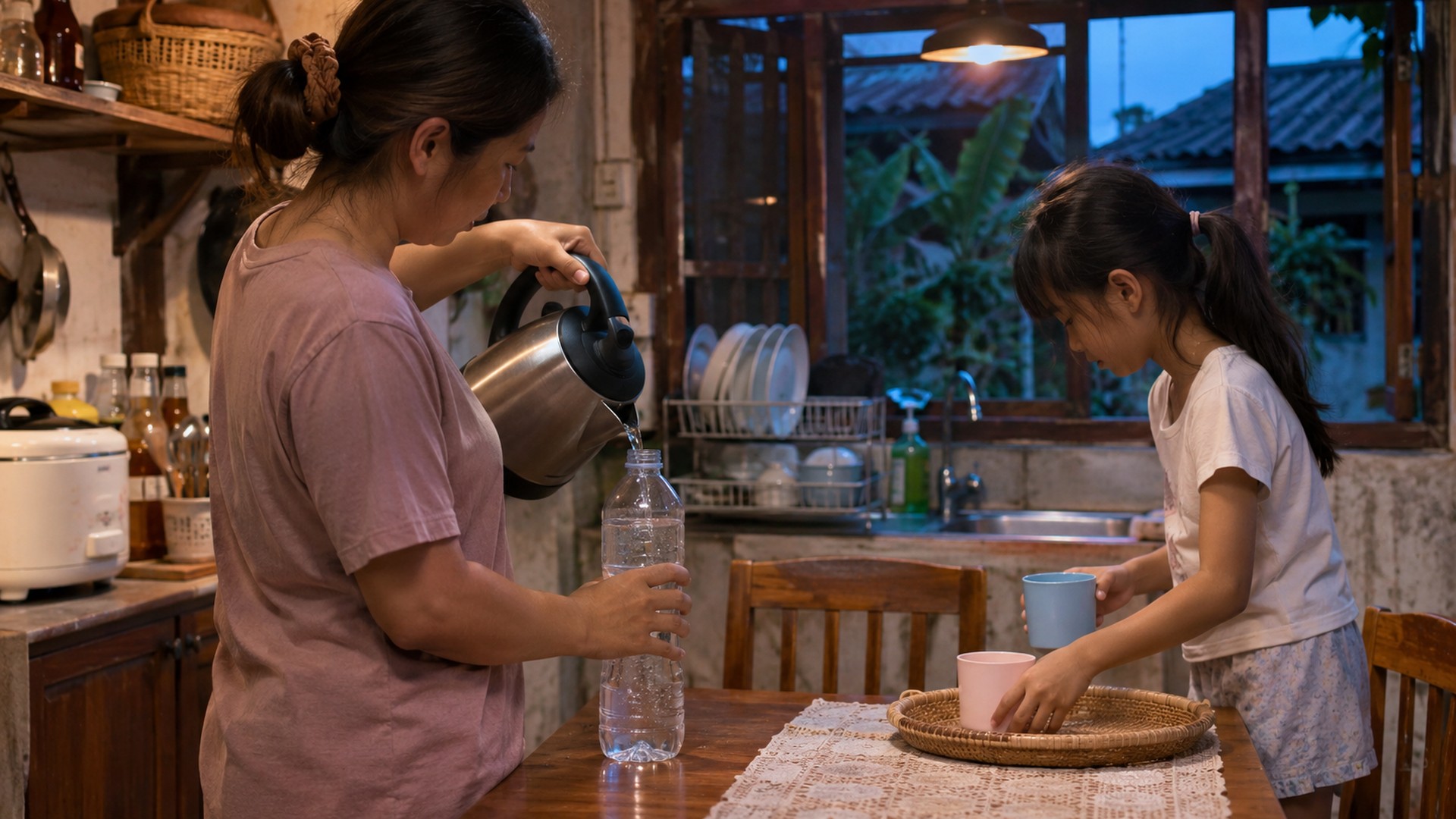
What makes tap water "drinkable"?
In Thailand, "drinkable tap water" means tap water that meets all three parts of the Department of Health criteria for drinkable tap water (2020):
- Physical: for example, turbidity no higher than 5 NTU (nephelometric turbidity units, the unit for cloudiness), color no higher than 15 platinum-cobalt units, and pH between 6.5 and 8.5.
- Chemical: for example, dissolved solids, iron, manganese, fluoride, and five toxic heavy metals: lead, total chromium, cadmium, arsenic and mercury.
- Microbiological: no coliform bacteria and no E. coli.
The Department of Health states that tap water produced and controlled to these criteria is safe for drinking, cooking, washing dishes and washing food ingredients. For the value of each item, see How to read Thailand's tap water standard (2020).
What does Thailand's "drinkable tap water" program certify?
The Department of Health is the certifying body. It checks whether tap water quality is fit for drinking. The published information is as follows:
| Water producer | Published certification information | How to find out whether your area has passed |
|---|---|---|
| Provincial Waterworks Authority (PWA, the state utility serving the provinces) | Has worked with the Department of Health on the program since 2000. By 6 September 2024 it had declared 256 drinkable tap water areas in 224 branches. | Ask the local branch, or read the branch's annual water quality report. Hotline 1662. |
| Metropolitan Waterworks Authority (MWA, the state utility serving the Bangkok metropolitan area) | On 25 July 2025 the Department of Health awarded a certificate recognizing its service area as a drinkable tap water area. MWA says it takes more than 7,000 samples a year from more than 3,000 points. | Contact MWA. |
| Village water supplies (run by local government organizations) | The Department of Health tests village water supply quality every year. Results depend on each system. | Ask the local government organization or the village water supply operator for the latest test results. |
A common misunderstanding: drinkable tap water certification applies to the water delivered by the system. The water at your tap also depends on the storage tank, pipes and filters in your building. Tap water from a certified area is drinkable when the storage tank and household pipes are also looked after.
How to check whether the tap water at home is safe to drink
| Step | What to check | Why |
|---|---|---|
| 1 | Who supplies the water, and whether the area has been declared a drinkable tap water area | This information comes from laboratory testing against the full criteria |
| 2 | Water at the tap is clear, with no unusual color, smell or sediment | Your eyes can only judge physical quality. Arsenic and heavy metals can only be known by testing |
| 3 | The storage tank and household pipes are looked after | The Department of Health recommends cleaning storage tanks every 6 months and keeping household pipes in good condition to prevent rust and dirt |
| 4 | If you still have doubts, test the water at the tap | Especially for lead. The World Health Organization (WHO) says lead must be measured at the tap, because it often dissolves from pipes and fittings inside buildings |
What does a chlorine smell mean?
Tap water carries residual chlorine to kill germs that may enter the pipes along the way. The Department of Health explains that a faint chlorine smell shows the water has been disinfected. If you do not like the smell, let the water stand in a container for about 30 minutes, or filter it with activated carbon.
Cloudy, colored or bad-smelling tap water
Turbidity is one of the items in the drinkable tap water criteria (no higher than 5 NTU). If the water at your tap is cloudy, colored, smells, or has unusual sediment, the Department of Health recommends reporting it to the water producer. In Thailand you can use, for example, the Department of Health hotline 1478, the Provincial Waterworks Authority hotline 1662, or the local government organization that runs the village water supply. A report helps the producer find the cause in the system, which no household can fix on its own.
What does boiling water do?
Boiling kills germs but does not remove arsenic or heavy metals. Thailand's Ministry of Public Health and agencies in the United States say the same thing:
- On 11 November 2026, the Ministry of Public Health, the Department of Health and the Department of Medical Services advised people in at-risk areas that boiling or adding chlorine does not remove arsenic.
- On 17 November 2026, Thailand's Minister of Public Health stated that boiling does not make heavy metals go away.
- Documents from the US Centers for Disease Control and Prevention (CDC) and the US National Institute of Environmental Health Sciences state that boiling does not remove arsenic, and that if boiling evaporates a lot of the water, the concentration may rise. The Pennsylvania drinking water agency, citing US Environmental Protection Agency (EPA) rules, says the same.
- The US EPA states that boiling does not reduce lead.
| Household method | Deals with germs | Removes arsenic and heavy metals |
|---|---|---|
| Boiling | Yes | No. If boiled long enough to evaporate a lot of water, the concentration may rise |
| Adding chlorine | Yes (this is how tap water is disinfected) | No |
| Filter with a UV (ultraviolet) lamp | Yes | No |
| Letting water stand 30 minutes, or an activated carbon filter | Used to reduce chlorine smell, as the Department of Health advises | Not part of that advice |
| Reverse osmosis (RO), ion exchange, distillation, a filter certified to remove that substance | — | These are the methods agencies refer to. Test the water again after installation to confirm they work |
Health news reports also note that ordinary home water filters may not reduce arsenic to a safe level. Choosing a treatment method should therefore start with knowing which substances are in the water, and how much.
When should you boil tap water?
The Department of Health advises that if you are not confident the water is clean, boil it or use a filter with a disinfection system such as a UV lamp, especially for young children, older people and people with weak immune systems. Boiling suits concerns about germs, not heavy metals.
Reducing lead exposure from household pipes
- Use cold tap water for drinking, cooking and preparing infant formula (US EPA advice).
- Run the tap for 1–2 minutes before use when water has been sitting in the pipes for a long time (a Sanook.com fact-check, citing the Department of Health).
- Change filter cartridges on schedule, and replace very old pipes or taps.
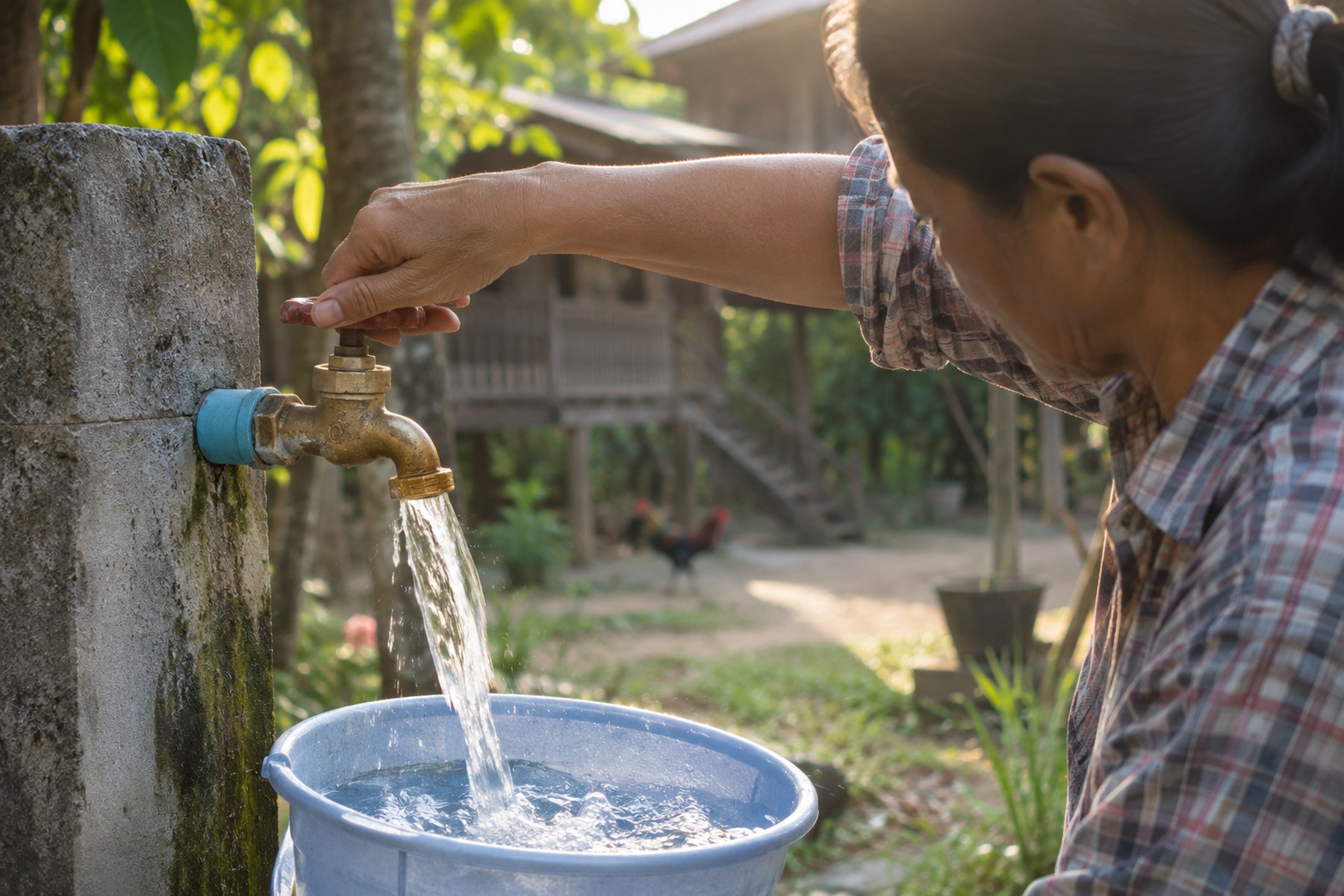
Is village tap water safe to drink?
It depends on the test results for each village water supply. Thailand has about 70,000 village water supply systems. Under the Ministry of Interior regulation on managing and maintaining village water supply systems (2005), they belong to local government organizations (municipalities and subdistrict administrative organizations). Water quality therefore varies with the raw water source, the condition of the system, and how it is maintained.
The Department of Health's village water supply report for fiscal year 2025 lists the items that most often fail the criteria, from most to least frequent: coliform bacteria, E. coli, dissolved solids, iron and turbidity. Arsenic was found in some areas.
This means you need to look at the results for each system, and the most common problem is germs, which a disinfection system that runs consistently can handle.
On 17 November 2026, Thailand's Minister of Public Health advised village water supplies to test water quality often, together with local government organizations. In areas where agencies have announced arsenic monitoring, people should use water from sources that have been tested and follow the advice of local agencies.
Why seeing test results matters
A study in Ronphibun District, Nakhon Si Thammarat Province, in 1994–1997 found that even after the community had tap water, only 3.6% of households drank it. This example shows that having a water supply is not enough on its own. People need confidence in its quality, and that confidence starts with testing the water and showing the results.
Can you drink tap water in Thailand?
Putting the points above together: tap water in Thailand is drinkable where the supplier's area has been certified under the Department of Health criteria (2020) and the building's storage tank and pipes are maintained. The Provincial Waterworks Authority and the Metropolitan Waterworks Authority publish their certification status, and village water supplies vary from system to system. If you are unsure about a particular supply, ask the water producer for its latest results, and remember that boiling deals with germs, not heavy metals.
What to do if a water test exceeds the criteria
- Stop using that water for drinking and cooking for now. Use water from a tested source, such as tap water that meets the criteria or bottled water bearing the mark of Thailand's Food and Drug Administration (FDA).
- Send a sample to a laboratory for confirmation, because results from field test kits are screening results.
- Inform the water producer, or the local government organization that runs the village water supply.
- If you have been drinking that water for a long time, or have unusual symptoms, consult a subdistrict health promoting hospital (the local primary care unit) or a nearby hospital.
This sequence is synthesized from the advice of Thailand's Ministry of Public Health and drinking water agencies abroad. If your local agency has specific advice, follow the local agency first.
How M-Sense helps
The clearest answer to "is tap water safe to drink?" comes from test results. M-Sense is a portable heavy metal test kit for water from the National Nanotechnology Center (NANOTEC), National Science and Technology Development Agency (NSTDA). It tests for arsenic, lead, cadmium and mercury in about 5 minutes and reports results as numbers from ppb to ppm (parts per billion to parts per million). It can be used on surface water, groundwater, and community water for drinking and household use.
M-Sense helps agencies and village water supply operators carry out screening and monitoring at the sampling point. Results above the criteria should be confirmed with standard laboratory methods. M-Sense does not test for germs, turbidity or the other chemicals in the criteria, so it is used together with the other tests in the drinkable tap water criteria. See what it detects on What it detects and the criteria, and how it works on How M-Sense works.
Frequently asked questions
Is tap water safe to drink straight from the tap? Yes, if the water in your area meets the Department of Health drinkable tap water criteria (2020) and the storage tank and household pipes are looked after. Certification covers the production and delivery system, not the storage tank and pipes in your building.
Does boiling tap water remove arsenic or heavy metals? No. Boiling only kills germs. Thailand's Ministry of Public Health and US agencies agree that boiling does not remove arsenic or heavy metals, and if water is boiled long enough to evaporate a lot of it, the concentration may rise.
Tap water smells of chlorine. Is it safe to drink? A faint chlorine smell shows the water has been disinfected. If you do not like the smell, the Department of Health recommends letting the water stand in a container for about 30 minutes, or filtering it with activated carbon.
How do I know whether my area is a drinkable tap water area? Ask the local water producer, such as the Provincial Waterworks Authority branch (hotline 1662), the Metropolitan Waterworks Authority, or the local government organization that runs the village water supply. Many Provincial Waterworks Authority branches publish annual water quality reports.
Is village tap water safe to drink? It depends on the test results for each system. The most common problem is germs. Ask the local government organization or the water supply operator for the latest results.
Who should I report cloudy tap water to? Report it to the local water producer, or the Department of Health hotline 1478. If you are worried about your health, consult a subdistrict health promoting hospital or the local public health office.
Want to test village water supplies in your area?
Ask NANOTEC · For agencies · Field use
References
- Public Health Laboratory Division, Department of Health. Criteria for drinkable tap water, Department of Health, 2020 (document SD-RLDC-006, effective 28 April 2023). In Thai.
- Department of Health. Press release on tap water produced to standard being clean and safe, 11 April 2025. In Thai.
- ThaiPR.net. Ministry of Public Health and the Provincial Waterworks Authority join forces to drive drinkable tap water, 6 September 2024. In Thai.
- Daily News. Department of Health awards drinkable tap water certificate to the Metropolitan Waterworks Authority, 25 July 2025. In Thai.
- Daily News. News on the Provincial Waterworks Authority and hotline 1662, 4 September 2026. In Thai.
- Bureau of Food and Water Sanitation, Department of Health. Village water supply quality situation and performance, fiscal year 2025 (data as of 24 July 2025). In Thai.
- Bureau of Food and Water Sanitation, Department of Health. Household drinking water quality situation, 2009–2018. In Thai.
- Ministry of Interior regulation on managing and maintaining village water supply systems, 2005. In Thai.
- Hfocus. Ministry of Public Health warns people in at-risk areas to avoid arsenic-contaminated water, 11 November 2026, and news on the Minister of Public Health, 17 November 2026. In Thai.
- Sanook.com fact-check. Does boiling tap water remove contaminants, heavy metals and lead?, 6 May 2026. In Thai.
- PPTV. Beware of arsenic contamination: boiling does not remove it, 3 ways to reduce risk, 16 November 2026. In Thai.
- Centers for Disease Control and Prevention. Arsenic in private well water (archived document).
- National Institute of Environmental Health Sciences. Arsenic and your health.
- Pennsylvania Department of Environmental Protection. Arsenic in drinking water.
- U.S. Environmental Protection Agency. Lead Poisoning and Your Children, 2024.
- Minnesota Department of Health. Arsenic in well water.
- World Health Organization. Guidelines for drinking-water quality, 4th edition incorporating the first and second addenda, 2022 (chemical fact sheet: lead).
- Chongsuvivatwong V, et al. Follow up of water use in a tin mining area affected with arsenic poisoning. Southeast Asian J Trop Med Public Health 2000;31(4):769-74.
- National Nanotechnology Center. Portable electrochemical test kit innovation for heavy metal contamination in water (M-Sense).