

What Is a Village Water Supply? Who Owns It, Who Runs It, and How Water Is Treated Before It Reaches Homes
A village water supply is a system that takes water from a groundwater well or a surface water source, treats it, and delivers it by pipe through water meters to the people of a village 24 hours a day. In Thailand, every village water supply is the property of a local government organization (such as a municipality or a subdistrict administrative organization), and there are about 70,000 of them nationwide. This article explains who is responsible for which part, how groundwater and surface water systems differ, and what steps the water goes through before it comes out of the tap at home.
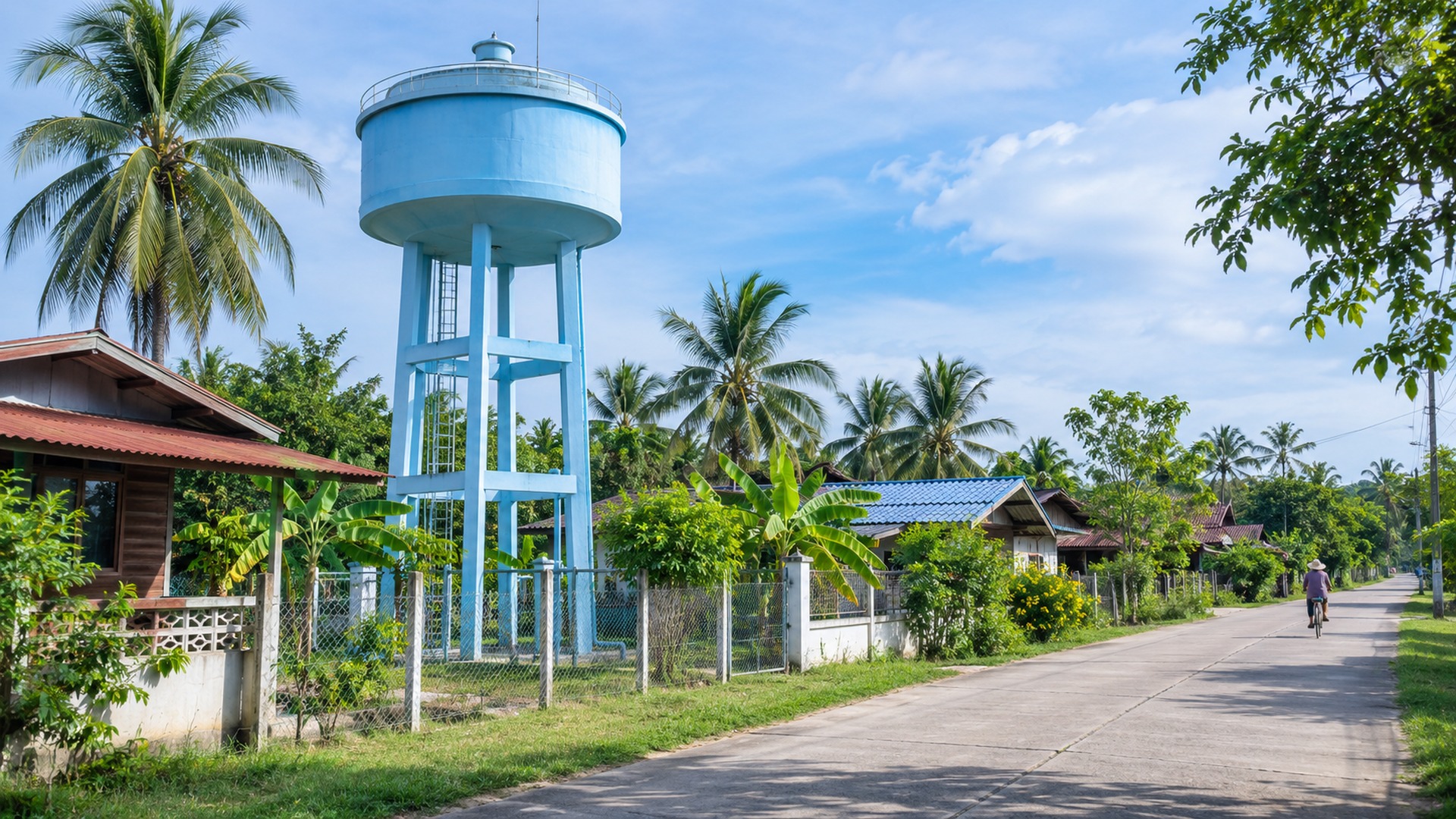
What is a village water supply?
Thailand's Department of Local Administration (DLA) manual on criteria and quality standards for village water supply systems of local government organizations (May 2022) defines a village water supply system as taking water from natural sources, either underground or surface water, putting it through treatment steps to make it clean according to technical principles, and then supplying it to people in the village for drinking and household use, by pipe through water meters, 24 hours a day.
A village water supply is different from the tap water produced by Thailand's two state water utilities, the Provincial Waterworks Authority and the Metropolitan Waterworks Authority. The regulation that governs village water supplies excludes systems under the responsibility of these two agencies. Village water supplies are therefore small systems that communities and local governments look after themselves, and they are the main water source for many people in rural Thailand. In that sense they are Thailand's version of a rural or community water supply.
Who owns and who runs a village water supply?
Clause 16 of the Ministry of Interior Regulation on the Administration and Maintenance of Village Water Supply Systems (2005) states that a village water supply is the property of the local government organization, which assigns a committee to manage it. Many village water supply systems were originally built by the Department of Water Resources or the Department of Groundwater Resources and were later transferred to local governments under Thailand's decentralization laws.
The DLA manual sets out 2 management models:
- Model 1: managed by a water supply committee. The committee is elected by the water users and serves a clear term, under the 2005 Ministry of Interior Regulation.
- Model 2: managed by the local government organization. The local government appoints a water supply manager and uses its own budget.
Whichever model is used, a village water supply works well because several groups work together.
| Who | Main duties |
|---|---|
| Water users | Elect representatives to the committee, follow the water supply's rules, help look after the system, and follow the committee's work |
| Village water supply committee | Sets rules with the approval of water users, manages the system so everyone gets water, handles income and expenses, and reports to the local government and water users |
| System operator (production controller) | Turns the system on and off and controls it, maintains and repairs it, reports problems to the committee, and seeks new knowledge to improve the system |
| Local government organization | Owns the system, improves and repairs it, checks water quality, and builds the skills of system operators |
| Supporting agencies | The Department of Local Administration, the Department of Water Resources, the Department of Groundwater Resources and the Department of Health jointly set criteria, assess systems and give technical advice |
The system operator is one of the most important people, because daily water quality depends on running the system, adding chlorine and washing the filter tanks regularly.
Groundwater systems vs surface water systems
Village water supplies fall into 2 main types according to their raw water source. The difference lies in the raw water and in the treatment steps it needs.
| Topic | Groundwater system | Surface water system |
|---|---|---|
| Raw water source | Groundwater wells | Streams, swamps, canals, ponds, reservoirs, rivers, springs and shallow wells |
| Raw water quality criteria in the manual | The standards for groundwater fit for consumption, under the Ministry of Natural Resources and Environment Notification of 2008; a water sample must be sent for analysis before the well is used to produce tap water | Thailand's surface water quality standards, classes 1–4, under National Environment Board Notification No. 8 (1994) |
| Treatment section | Filter tanks, filter sand and related equipment; many systems add aeration before the filter tank | Coagulation, flocculation and sedimentation tanks and sand filters, with related equipment |
| What operators often have to deal with | Iron, manganese, color, odor and substances dissolved from rock and soil layers | Turbidity, sediment and germs that change with the seasons |
| Shared parts | A clear water tank, a chlorine dosing system for disinfection, an elevated water tower or pressure tank, and distribution pipes through water meters | Same |
Groundwater systems themselves come in several sizes. The Department of Health's assessment form for village water production systems (draft) separates 3 types: pumping from the well up to the water tower and supplying directly; pumping into a clear water tank before the water tower; and pumping through a filter system into a clear water tank before the water tower. To learn what groundwater should be tested for, read Is well water safe to drink?
How a village water supply treats water before it reaches homes
The path of water in a typical village water supply, summarized from the DLA manual and the Department of Health assessment form, is shown below. Each system may have more or fewer steps depending on how it was built.
| Step | Stage | What happens |
|---|---|---|
| 1 | Raw water pumping | A raw water pump draws water from a groundwater well or surface source into the system |
| 2 | Aeration (some groundwater systems) | Water is exposed to air, and dissolved iron turns into particles that can be filtered out |
| 3 | Coagulation and sedimentation (surface water systems) | A coagulant such as alum is added so that turbidity clumps together and sinks to the bottom of the tank |
| 4 | Filtration | Water flows through a sand filter tank; some systems use other filter media as well, such as anthracite or manganese greensand |
| 5 | Clear water storage and disinfection | Chlorine is added to kill germs, and the filtered water is stored in a clear water tank |
| 6 | Pumping to the water tower or pressure tank | A treated water pump sends water up the water tower to give enough pressure to supply the whole village |
| 7 | Pipe distribution | Water passes through the main meter and main pipes to each home's meter and tap |
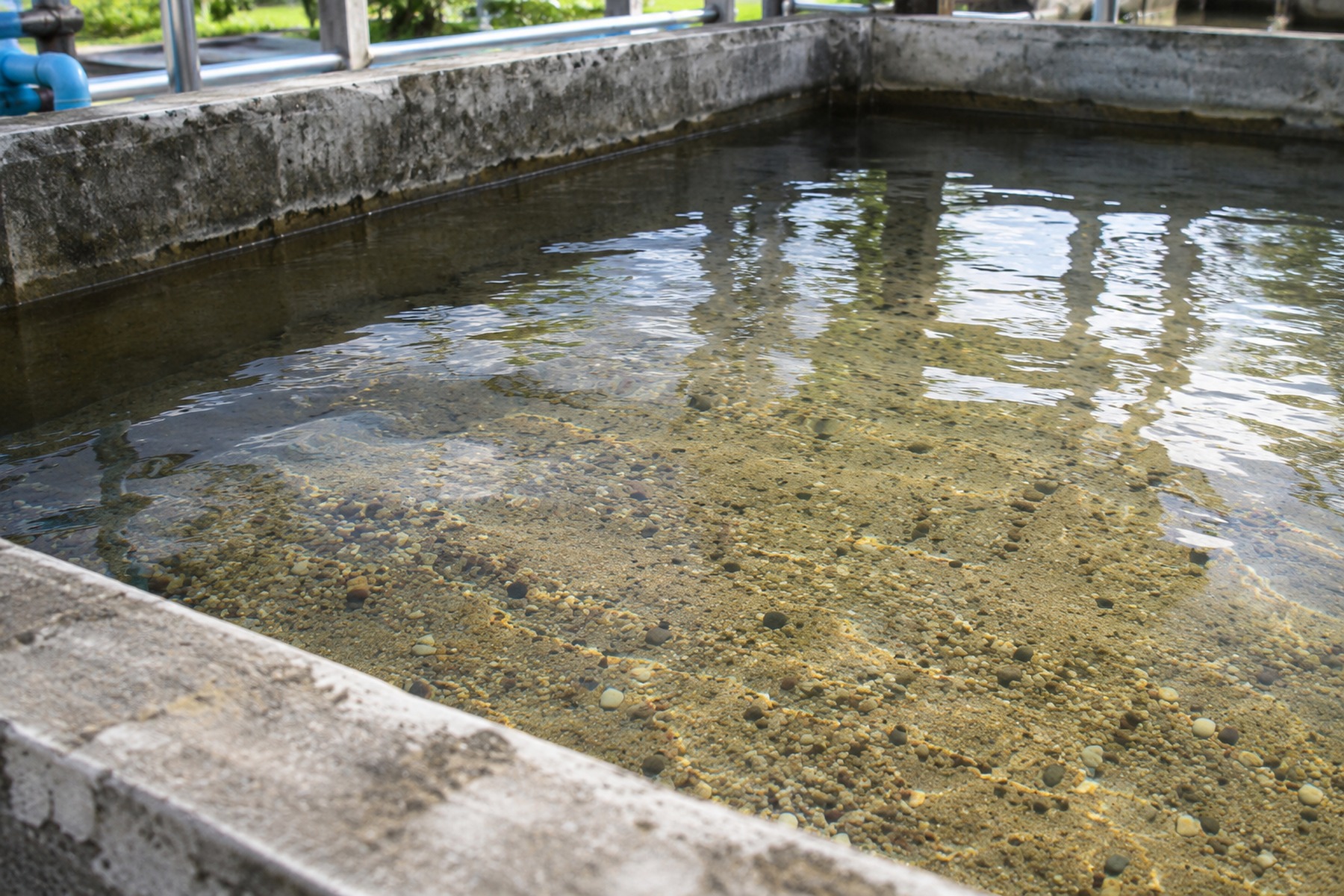
Why some chlorine must remain in the water at home
The chlorine added in step 5 is not all used up in the tank. Some must remain in the water. This is called free residual chlorine, and it kills germs that may enter the pipes along the way. The DLA manual requires residual chlorine at the end of the pipe to be between 0.2–0.5 mg/L, and the 3C approach calls for measuring it once a month at the user's home farthest from the plant, using a free residual chlorine test kit (known in Thailand as the "Or. 31" kit).
A faint smell of chlorine at the tap is therefore a sign that the water has been disinfected. If you do not like the smell, see how to deal with it at home in Is tap water safe to drink?
How to keep village water up to standard
The DLA manual requires the tap water produced to meet Thailand's Department of Health criteria for drinkable tap water (2020). Details of these criteria are in Thailand's tap water standard (Department of Health, 2020)
The maintenance tasks set out in the manual and the assessment form are:
| Task | Frequency | Source |
|---|---|---|
| Backwash the filter sand | At least once a day | Department of Health assessment form for village water production systems (draft) |
| Add chlorine and measure free residual chlorine | Regularly, recording the result every time | Department of Health assessment form |
| Inspect and scrub the filter tank | At least once a year | Department of Health assessment form |
| Clean the clear water tank and water tower: drain sediment, scrub off algae and disinfect the tank | At least once a year | Department of Health assessment form |
| Check water quality with simple field equipment at the production or distribution point | Every 3 months | DLA manual |
| Send tap water samples to the agency responsible for water quality testing | At least once a year | DLA manual |
The 3C approach for clean village water
The Department of Health and the Department of Local Administration use the 3C approach as a framework for improving village water supplies.
- Clear: keep the water supply system clean and orderly, and produce water correctly according to technical principles.
- Clean: produce tap water that meets the Department of Health criteria for drinkable tap water (2020), with water samples taken at the start of the pipe and sent to a laboratory.
- Chlorine: monitor free residual chlorine with a simple field test kit.
A village water supply that meets all 3 can apply for certification as a clean village water supply. The approach helps local governments and operators see clearly what needs to be done and how to measure it.
What keeps a community water supply sustainable?
Running a community water supply is not only about pumps and filter tanks. It is a service that needs enough income to pay for electricity, chlorine, filter media and repairs. The DLA manual therefore also sets management standards.
- Fair water rates: rates must be based on production costs and on what water users can afford.
- Open accounts: income and expense accounts that water users can check, to build trust.
- Less water loss: the production controller must make sure there are no leaking pipes and no free water use, because lost water is lost income needed to maintain the system.
- Communication with the community: channels to share news and water quality results, and to let water users give feedback.
Each household can help a lot, for example by telling the operator about leaks or unusual water, paying water bills on time, and looking after the household storage tank. The Department of Health recommends cleaning household storage tanks every 6 months, because water quality at the tap also depends on the storage tank and pipes inside the home.
Why water testing matters for a village water supply
The quality of village tap water varies with the raw water source, the condition of the system and how it is maintained. Water testing is both a tool for operators and a way to build confidence among water users.
- For system operators: results show which step needs adjusting, for example too little chlorine, a filter tank that needs washing, or raw water containing substances the existing system cannot yet handle.
- For local governments: results help set budget priorities, such as what to repair, improve or add.
- For water users: publishing test results for the community helps villagers feel confident using tap water.
As for whether village tap water is safe to drink, the answer depends on each system's test results. Read how to check, and what you can do at home, in Is tap water safe to drink? and the different testing methods in Water quality testing methods
Upgrading existing systems instead of building new ones
When testing finds substances the existing system cannot yet handle, one option is to upgrade the existing system. Research by the National Nanotechnology Center (NANOTEC), part of Thailand's National Science and Technology Development Agency (NSTDA), under the A-QUALITY program (clean water innovation for quality of life) uses this approach with village water supplies.
- It starts with water quality testing, then chooses a treatment method based on the substances found, for example adding a low-energy sedimentation tank and a filter tank filled with surface-modified biochar that adsorbs arsenic to the existing system.
- The cost of upgrading an existing system is 13–26% of building a new one.
- At Ban Rim Kok, Mae Yao Subdistrict, Mueang Chiang Rai District, arsenic in the raw water fell from 0.069 mg/L to 0.0035 mg/L at the water tower after passing through the system.
- Researchers trained village water supply operators in Chiang Rai Province 4 times, 540 people in total.
Before an upgrade begins, NANOTEC's report recommends that each area prepare 4 kinds of information: raw water quality data; the condition and production capacity of the existing system; the local agency's readiness to operate and maintain the system; and who is responsible for maintenance, together with how water quality will be monitored after installation.
NANOTEC's working principle is "researchers as mentors, communities as owners, and local government as supporters", which fits the structure of village water supplies, already owned by communities and local governments. See examples from the field on the Field use page.
How M-Sense can help
M-Sense is a portable heavy metal test kit for water from NANOTEC, NSTDA. It tests arsenic, lead, cadmium and mercury in about 5 minutes and reports results as numbers from ppb to ppm (parts per billion to parts per million). It can be used with groundwater, surface water and community water for drinking and household use.
For village water supplies, M-Sense helps local governments and public health agencies screen for heavy metals on site at sampling points, such as the raw water well, the clear water tank or the water tower, before deciding which points should be sent to a laboratory for confirmation. It can also be used to follow up after a system upgrade. M-Sense does not measure chlorine, germs or turbidity, so operators' daily work still relies on chlorine test kits and testing under the Department of Health criteria as before. See what it detects on the What it detects and the limits page.
Frequently asked questions
Who owns a village water supply? It is the property of the local government organization, such as a municipality or a subdistrict administrative organization, under the 2005 Ministry of Interior Regulation. Management may be assigned to a water supply committee elected by the water users.
Who should I contact about a problem with village tap water? Contact the system operator, the village water supply committee, or the local government organization that owns the system. If you have health concerns, consult your subdistrict health promoting hospital or call the Department of Health hotline at 1478.
Which is better, a groundwater system or a surface water system? Neither is always better. It depends on the water sources available in the area. Surface water systems have to deal more with turbidity and sediment, while groundwater systems often have to deal with iron, manganese and substances dissolved from soil and rock layers. Both must disinfect with chlorine.
Why does village tap water smell of chlorine? Because some free residual chlorine must remain in the water to kill germs that may enter the pipes. The DLA manual requires 0.2–0.5 mg/L of residual chlorine at the end of the pipe.
How often should a village water supply test its water? The DLA manual calls for testing with simple field equipment every 3 months and sending samples to a testing agency at least once a year. Residual chlorine should be measured regularly.
How many village water supplies are there in Thailand? About 70,000, according to a Department of Health report for fiscal year 2025.
Want to test for heavy metals in your area's village water supply?
Ask NANOTEC · For agencies · Field use
References
- Department of Local Administration, Ministry of Interior, Thailand. Manual on criteria and quality standards for village water supply systems of local government organizations, May 2022.
- Ministry of Interior Regulation on the Administration and Maintenance of Village Water Supply Systems, 2005.
- Bureau of Food and Water Sanitation, Department of Health. (Draft) Assessment form for village water production systems (groundwater sources), 2026.
- Department of Health. Press release on improving village water supply systems under the 3C approach, 21 November 2024.
- Division of Public Health Laboratory, Department of Health. Department of Health criteria for drinkable tap water, 2020 (document SD-RLDC-006, effective 28 April 2023).
- Bureau of Food and Water Sanitation, Department of Health. Village water supply quality results and situation, fiscal year 2025 (data as of 24 July 2025).
- National Nanotechnology Center. Report on the use of technology to solve water quality problems and improve community access to clean water.
- National Nanotechnology Center. Arsenic management innovation for sustainable clean tap water production (A-QUALITY Community Water Clinic).
- National Nanotechnology Center. Portable electrochemical test kit for heavy metal contamination in water (M-Sense).