
Water Quality Meter Types: What Each One Measures and How to Choose the Right One
A water quality meter, in the broad sense, comes in 5 main types: meters for basic values (such as pH and TDS), colorimetric water test kits, field heavy metal test kits, continuous monitors installed in a system, and laboratory instruments. Each type answers a different question. For example, a TDS meter tells you the overall amount of dissolved minerals, but it cannot tell you how much arsenic or lead is in the water. Choosing an instrument should therefore always start with the question "what do I want to know?"
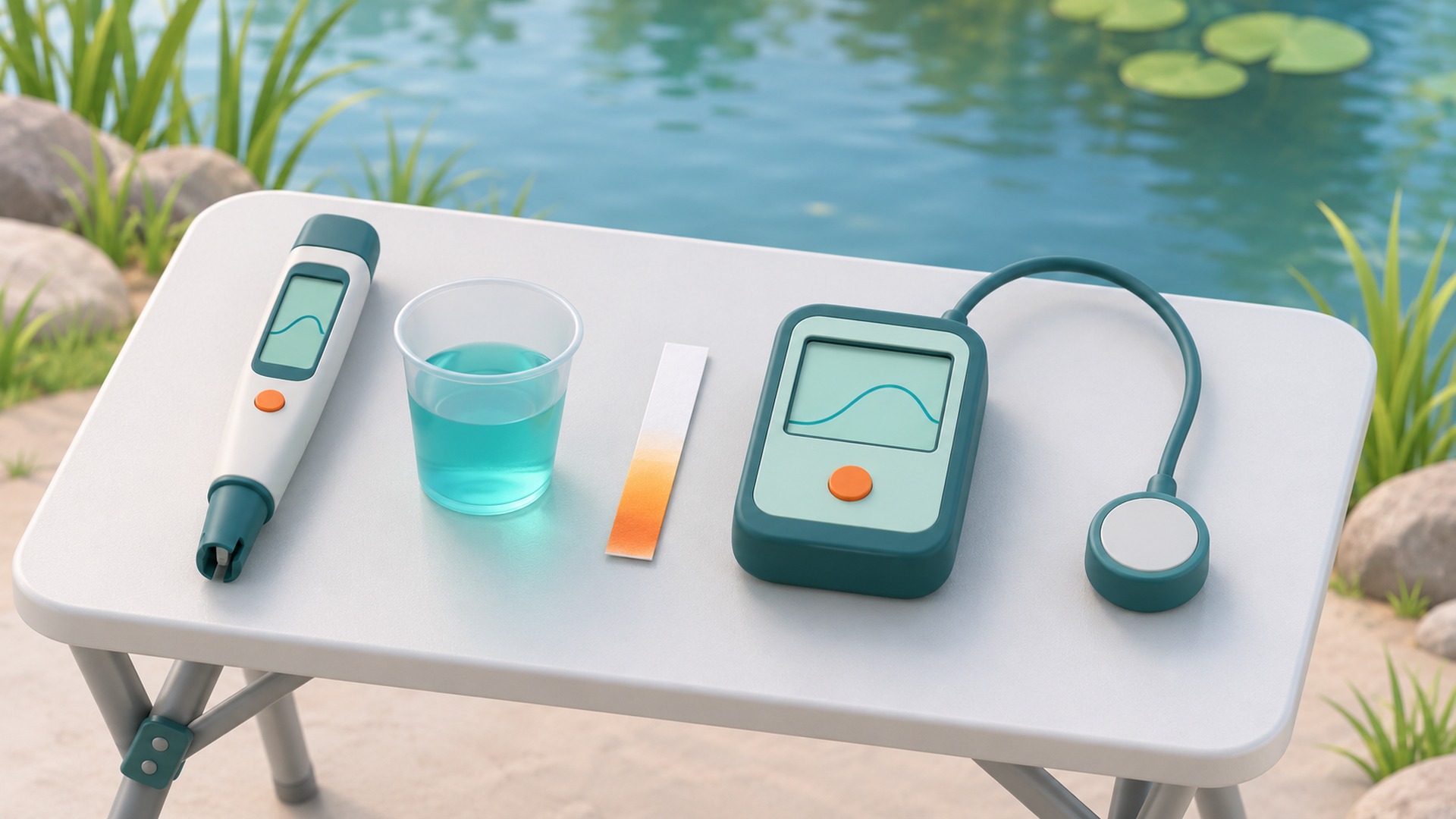
"Water quality" has many sides, and no single meter covers them all
Water quality covers many things. Thailand's Department of Health criteria for drinkable tap water (2020) have 21 items, which fall roughly into 3 groups:
- Physical: for example, turbidity no higher than 5 NTU, color no higher than 15 platinum-cobalt units, and pH between 6.5 and 8.5.
- Chemical: for example, dissolved solids no higher than 500 milligrams per liter, iron, manganese, fluoride, and toxic heavy metals such as arsenic, lead, cadmium and mercury.
- Microbiological: no coliform bacteria and no E. coli.
Each group is measured by a different principle. Turbidity is measured from scattered light, pH from electrical potential, germs need culturing or a specific test kit, and heavy metals must be measured at very low levels. So no single water quality meter can measure every item. For the full set of criteria, see How to read Thailand's tap water standard (2020).
Type 1: Meters for basic values
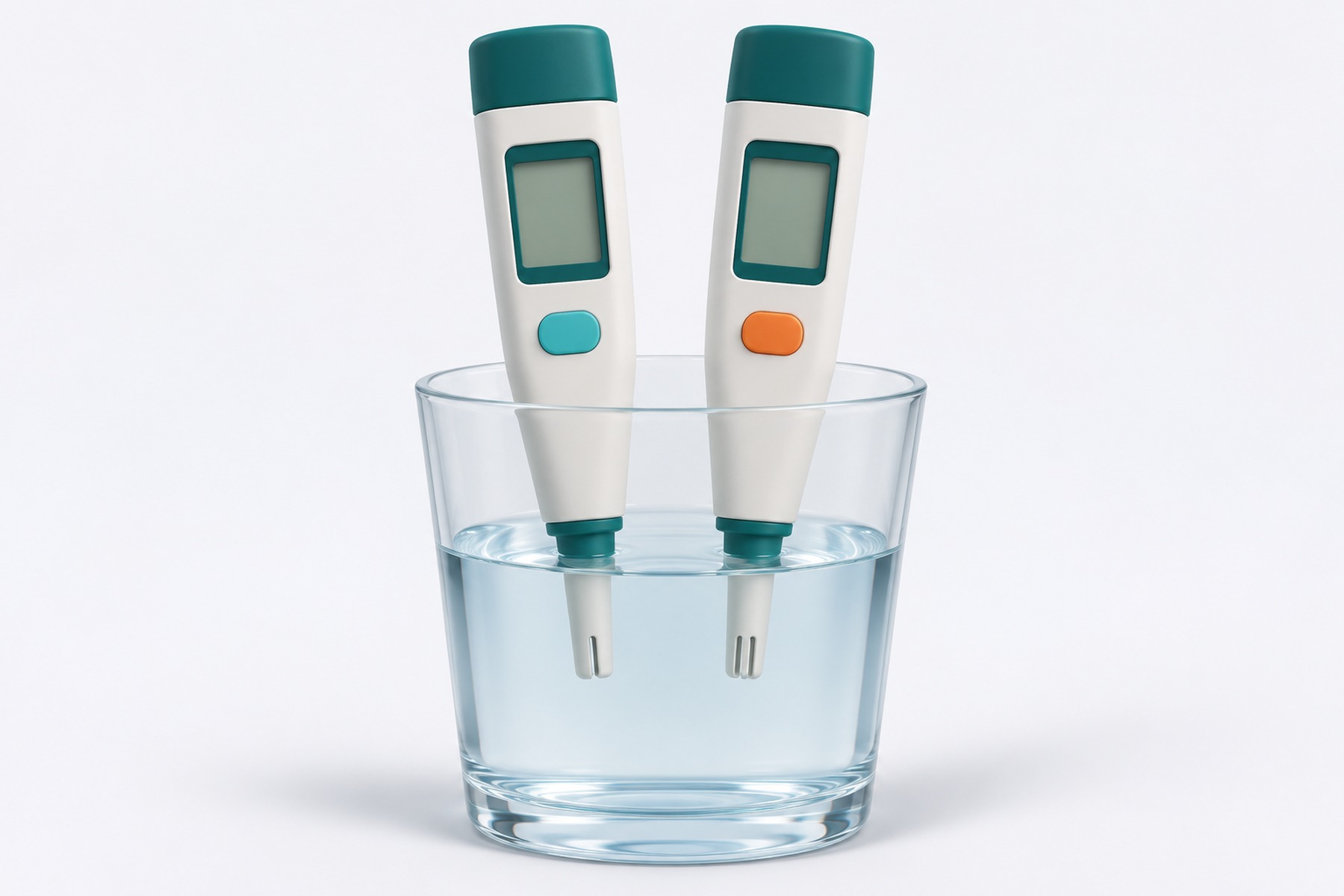
A meter is a handheld or benchtop instrument with a probe that you dip in water to read a value on the screen straight away. It is the most common type of water quality meter. It can measure the following values.
pH (acidity and alkalinity)
pH tells you whether water is acidic or alkaline. The drinkable tap water criteria range is 6.5–8.5. A pH probe must be calibrated with standard solutions before use.
Electrical conductivity (EC) and total dissolved solids (TDS)
Electrical conductivity (EC) tells you how well water conducts electricity. Water with a lot of dissolved minerals conducts well, while distilled water hardly conducts at all. Most meters that display TDS (total dissolved solids) actually measure EC and multiply it by a conversion factor. A TDS reading from a meter is therefore an "estimate." The laboratory reference method is to evaporate the water and weigh what is left.
Turbidity
Turbidity has its own unit, the NTU. A turbidity meter shines light through the water and measures the light scattered by suspended particles. In the field, staff can also use a visual turbidity tube. NANOTEC uses this kind of equipment together with a Mobile Jar Test kit to help set the right dose of alum for each area's raw water.
Dissolved oxygen (DO)
Dissolved oxygen (DO) is the amount of oxygen aquatic animals use to breathe, so it is usually measured in rivers, reservoirs and fish ponds rather than tap water. Cold water holds more oxygen than warm water, so the meter also needs a calibrated temperature probe.
Residual chlorine
Free residual chlorine in tap water is there to kill germs that may enter the pipes along the way. Water supply operators measure it at the end of the pipe network to check that disinfection is still working. Both meter and colorimetric versions are available.
Can a TDS meter measure heavy metals?
No. This is the most common misunderstanding about water quality meters, for 3 reasons:
- TDS tells you the amount, not the type. A document from the Virginia Household Water Quality Program at Virginia Tech states that a TDS measurement gives the total amount of dissolved substances, but does not identify what they are or where they come from.
- Most dissolved substances are not heavy metals. The World Health Organization (WHO) states that TDS consists mainly of inorganic salts, namely calcium, magnesium, potassium, sodium, bicarbonate, chloride and sulfate, plus small amounts of organic matter.
- The levels are very different. Compare the Department of Health drinkable tap water criteria (2020): dissolved solids no higher than 500 milligrams per liter, and arsenic no higher than 0.01 milligrams per liter. That is a 50,000-fold difference (calculated from the two criteria values). Arsenic at the criteria level hardly moves the TDS reading.
As a result, water with low TDS can have arsenic above the criteria, and water with high TDS may have no heavy metals at all, because it is simply hard water with a lot of calcium. TDS is useful for checking how a filter system is working, for example whether a reverse osmosis (RO) system is still removing minerals well, but it is not a heavy metal meter. To learn about heavy metals, you need a method that measures each metal directly (types 3 and 5 below). For more on units, see What are ppm and ppb?
Type 2: Colorimetric water test kits
A colorimetric test kit (often searched as a "water test kit") uses reagents that react with the target substance to produce a color. The color is then compared with a color chart or read with a small photometer. Kits come as dip strips, tubes and reagent powders.
- What they measure: kits exist for many items, such as chlorine, iron, manganese, fluoride, hardness, nitrate and arsenic. Each kit usually tests one substance.
- Result: a range of values from the color comparison (semi-quantitative). With a photometer, the number is more precise.
- Strengths: easy to use, mostly no electricity needed, and you can test many points in one day.
- Cautions: reading color depends on eyesight and lighting, some substances in water can interfere with the color, and reagents expire.
NANOTEC itself develops chemical test kits of this kind for water, such as kits for manganese, copper, iron and fluoride, used in its Community Water Clinic work. This shows that colorimetric kits are still a main field tool for many items. For how colorimetric arsenic kits work, see How many ways are there to test water quality?
Type 3: Field heavy metal test kits
When the question is "how much arsenic, lead, cadmium or mercury is there?", you need a tool designed specifically for heavy metals. Most field kits in this group that give a numerical result use an electrochemical technique: they measure the electrical signal produced by metals on a small electrode strip, and a reader converts it into a concentration. Each metal gives a signal at a different position, so several metals can be measured at once.
- Result: a concentration number at the sampling point, in the microgram-per-liter range, which is the range of drinking water criteria.
- Strengths: small instrument, little sample needed, fast results, and the same point can be retested often.
- Cautions: needs sample preparation reagents and good calibration, other substances in the water may interfere with the signal, and results are for screening and monitoring. Official confirmation still uses a laboratory.
Most people who search for a "heavy metal test kit" or a portable heavy metal meter are looking for this group. For the working principle in depth, see What is an electrochemical sensor?, and for the four metals, see Heavy metals in water: 4 types.
Type 4: Continuous monitors installed in a system
Continuous (online) monitors are installed permanently in a water treatment system, a distribution pipe, or a water source, and send readings all the time. Some systems send data to a display or network so it can be viewed remotely.
- What they measure: mostly basic values such as pH, EC/TDS, turbidity, residual chlorine, dissolved oxygen and temperature. Sometimes several probes are combined in one unit placed in the water source.
- Strengths: you see changes right away, such as turbidity spiking after heavy rain, or a filter system starting to wear out.
- Cautions: probes must be cleaned and calibrated regularly. Without maintenance, readings gradually drift.
An example from NANOTEC's work: a nanotechnology drinking water filter with a capacity of 250 liters per hour has a display showing total dissolved solids (TDS) and electrical conductivity (EC) in real time, helping operators see that the filter system is working normally.
Type 5: The laboratory
When you need the most detailed results, or results for an official report, samples must go to a laboratory, which has the full range of instruments for chemistry, microbiology and heavy metals. For heavy metals, common instruments are inductively coupled plasma mass spectrometry (ICP-MS) and atomic absorption spectrometry (AAS). Laboratories accredited to ISO/IEC 17025 have quality control systems for their analytical results.
The limitations are that samples must be stored and transported according to the laboratory's requirements, and you have to wait for results, so it is not convenient for frequent retesting at the same point.
What do you want to know, and which type fits?
| What you want to know | Which type to use | Notes |
|---|---|---|
| Is the water acidic or alkaline? | Type 1, pH meter | Calibrate the probe before use |
| How much dissolved mineral is there? Is the filter system still working? | Type 1, EC/TDS meter, or type 4 | Gives an overall value, not the type of substance |
| How cloudy is the water? | Type 1, turbidity meter, or a turbidity tube | Unit is NTU; drinkable tap water criteria: no higher than 5 |
| Is there enough chlorine left to disinfect? | Type 1 or type 2 | Measure at the end of the pipe network |
| Does well water contain iron or manganese? | Type 2, colorimetric kit | Confirm with type 5 before investing in a treatment system |
| How much arsenic, lead, cadmium or mercury is there? | Type 3, field heavy metal test kit | A TDS meter cannot answer this |
| Results for an official report | Type 5, laboratory | Choose an accredited laboratory |
| Are coliforms or E. coli present? | Specific microbial test kit, or type 5 | Basic meters cannot measure germs |
| Is the water source suitable for aquatic animals? | Type 1, DO meter, or type 4 | Values change with temperature and time of day |
Choosing the right water quality meter: 4 questions
1. What will the results be used for? For day-to-day system operation, a basic meter or a continuous monitor fits best. For screening to find risk points, a colorimetric kit or a field heavy metal test kit helps. For decisions or official reports, you need a laboratory.
2. How often, and at how many points? Testing many points in one day suits a portable water quality meter or kit. Testing the same point every day suits a permanently installed monitor.
3. Who will use it? Every type needs training. Even instruments that give a number still need proper calibration and storage. Choose an instrument that local users can actually maintain, with a manual in their language (Thai, for users in Thailand) or training.
4. Which set of criteria must the results be compared with? In Thailand, drinking water is compared with the Department of Health drinkable tap water criteria (2020), while river water is compared with the surface water quality standards (National Environment Board Notification No. 8, 1994). The instrument must measure low enough for those criteria; for example, the arsenic criterion for drinkable tap water is 0.01 milligrams per liter, or 10 ppb.
In practice, agencies often use several types in sequence. For example, water supply operators measure pH, turbidity and chlorine every day, public health staff use field test kits to screen for heavy metals from time to time, and only the points with suspicious results are sent to a laboratory for confirmation.
How M-Sense helps
M-Sense belongs to type 3 in this article. It is a portable test kit for heavy metal contamination in water that uses an electrochemical technique, developed by the National Nanotechnology Center (NANOTEC), NSTDA, under the A-QUALITY program. It tests for four metals: arsenic, lead, cadmium and mercury. It reports results as numbers from ppb to ppm, and a test takes about 5 minutes. It works with a portable reader, so testing can be done at the sampling point.
M-Sense does not measure basic values such as pH, turbidity or germs, so it is used together with the other types of instruments in this article. M-Sense was field-tested with the Regional Environment and Pollution Control Office 1 (Chiang Mai) in the Kok River basin in northern Thailand, compared against standard laboratory methods, and the results were consistent. On 15 November 2026 it was handed over to the Chiang Rai Provincial Public Health Office. M-Sense is used for screening and monitoring; suspicious results are still sent for confirmation with standard laboratory methods. See the principle on How M-Sense works, and what it detects on What it detects and the criteria.
Frequently asked questions
Which water quality meter can measure everything? No single instrument can. The drinkable tap water criteria have 21 items covering physical, chemical and microbiological quality, which are measured by different principles. Most work therefore uses several instruments together.
Does low TDS mean the water is safe? Not necessarily. TDS gives the overall amount of dissolved substances, mostly ordinary minerals. Heavy metals at criteria levels are present in such small amounts that they do not change the TDS reading. Water with low TDS can still contain heavy metals or germs.
What is the difference between a water test kit and a water quality meter? A water test kit usually means a set of colorimetric reagents that are read from a color and test one substance at a time. A meter means an instrument or reader that uses a probe or sensor and gives a numerical result. The two complement each other.
Can a portable heavy metal meter replace a laboratory? No. It complements the laboratory. Portable instruments help with fast screening and monitoring at the sampling point. Results above the criteria or suspicious results should be confirmed by an accredited laboratory.
My home water has a problem. Where should I start? Start with what you can observe, such as cloudiness, color, smell or stains, then ask the agency that runs the water supply or the local public health office which items should be tested. If you live in an area with a heavy metal alert, follow the advice of local agencies.
Is your agency planning heavy metal testing and monitoring in water?
Ask NANOTEC · See how agencies can request it
References
- Public Health Laboratory Division, Department of Health. Criteria for drinkable tap water, Department of Health, 2020 (document SD-RLDC-006). In Thai.
- National Environment Board Notification No. 8 (1994) on surface water quality standards. In Thai.
- World Health Organization. Guidelines for drinking-water quality, 4th edition incorporating the first and second addenda, 2022. Chemical fact sheet: Total dissolved solids.
- Benham B, Ling EJ. Virginia Household Water Quality Program: Total Dissolved Solids (TDS) in Household Water. Virginia Cooperative Extension, publication 442-666, 2024.
- Prasad L, Meehan M. Using Electrical Conductivity and Total Dissolved Solids Meters to Field Test Water Quality (WQ1923). North Dakota State University Extension, revised 2025.
- U.S. Geological Survey. Dissolved Oxygen and Water. Water Science School.
- Fakayode SO, et al. Electrochemical and Colorimetric Nanosensors for Detection of Heavy Metal Ions: A Review. Sensors, 2023.
- National Nanotechnology Center. Portable electrochemical test kit innovation for heavy metal contamination in water (M-Sense).
- National Nanotechnology Center. Arsenic management innovation for sustainable clean tap water production (A-QUALITY Community Water Clinic).
- National Nanotechnology Center. Drinking water production technology for communities and disaster areas.
- Krungthep Turakij (Bangkok Biz News). News on the handover of M-Sense to the Chiang Rai Provincial Public Health Office, 15 November 2026. In Thai.