

What Is an Electrochemical Sensor? How It Works and How It Measures Heavy Metals in Water
An electrochemical sensor is a device that uses the principles of electrochemistry to turn "a chemical in a sample" into "an electrical signal" that a reader can measure, and then converts that signal into a concentration. In water testing, this type of sensor is used to measure heavy metals such as arsenic, lead, cadmium and mercury at microgram-per-liter levels, with a small instrument that can be carried to the water source. This article explains what electrochemistry is, what an electrochemical sensor is made of, what a potentiostat and voltammetry do, and what to keep in mind when using one to test water.

What is electrochemistry?
Electrochemistry is the branch of chemistry that studies the link between chemical reactions and electricity. At its heart is "gaining and losing electrons." Some substances gain electrons and some lose them. When this kind of reaction happens on the surface of an electrode, electrons flow through a circuit and become an electrical current that can be measured.
We meet electrochemistry in daily life more than we think. The battery in a phone uses a chemical reaction to produce electricity. Electroplating uses electricity to deposit metal on the surface of an object. An electrochemical sensor uses the same principle the other way around: it applies a controlled voltage and measures the current produced by substances in the sample, to tell what is in the sample and how much.
What is an electrochemical sensor?
The International Union of Pure and Applied Chemistry (IUPAC) defines a chemical sensor as a device that converts chemical information, such as the concentration of one substance, into a signal that can be analyzed. A chemical sensor usually has two parts:
- The recognition part (receptor), which "captures" or reacts with the substance to be measured.
- The transducer, which turns that chemical change into a signal an instrument can read.
An electrochemical sensor is a chemical sensor that uses an electrode as its transducer. Depending on the measurement mode, the output is an electrical current, a voltage, or an electrical resistance.
The most familiar example is the fingerstick blood glucose meter. The test strip you insert into the meter is a small electrode. When a drop of blood is applied, the reaction on the electrode surface produces a current in proportion to the amount of sugar, and the meter converts that current into a number on the screen. Academic reviews in this field describe this type of glucose meter as a widely used electrochemical sensor. Sensors for heavy metals in water use the same idea; what differs is the target substance and the measurement method.
The main components: three electrodes
Most electrochemical sensors for analysis use a three-electrode system. Each electrode has a clear job.
| Electrode | Job | Simple comparison |
|---|---|---|
| Working electrode | Where the reaction of the target substance actually happens. The measured signal comes from this electrode | The "stage" where the performance takes place |
| Reference electrode | Holds a constant voltage and serves as the point of comparison, so the voltage of the working electrode is known precisely | A "ruler" that must not stretch or shrink |
| Counter electrode (or auxiliary electrode) | Completes the circuit so current does not have to flow through the reference electrode | An "outlet" that keeps the ruler from bending out of shape |
The counter electrode is kept separate because if current flowed through the reference electrode, the reference voltage would shift and the point of comparison would drift. Splitting the work across three electrodes lets the voltage at the working electrode be controlled precisely, which matters a great deal when several metals must be told apart.
The potentiostat is the controller
The three electrodes connect to a controlling instrument called a potentiostat. It does two jobs at once:
- Controls the voltage. It sets the voltage between the working electrode and the reference electrode to the desired value, or changes it step by step according to a program.
- Measures the current. It measures the current flowing between the working electrode and the counter electrode.
In a research laboratory, the potentiostat may be a benchtop instrument connected to a computer. For field work, the same circuit is shrunk into a portable reader. Users do not need to set it up themselves, because the program in the reader already defines the steps.
Voltammetry: reading a substance's "fingerprint"
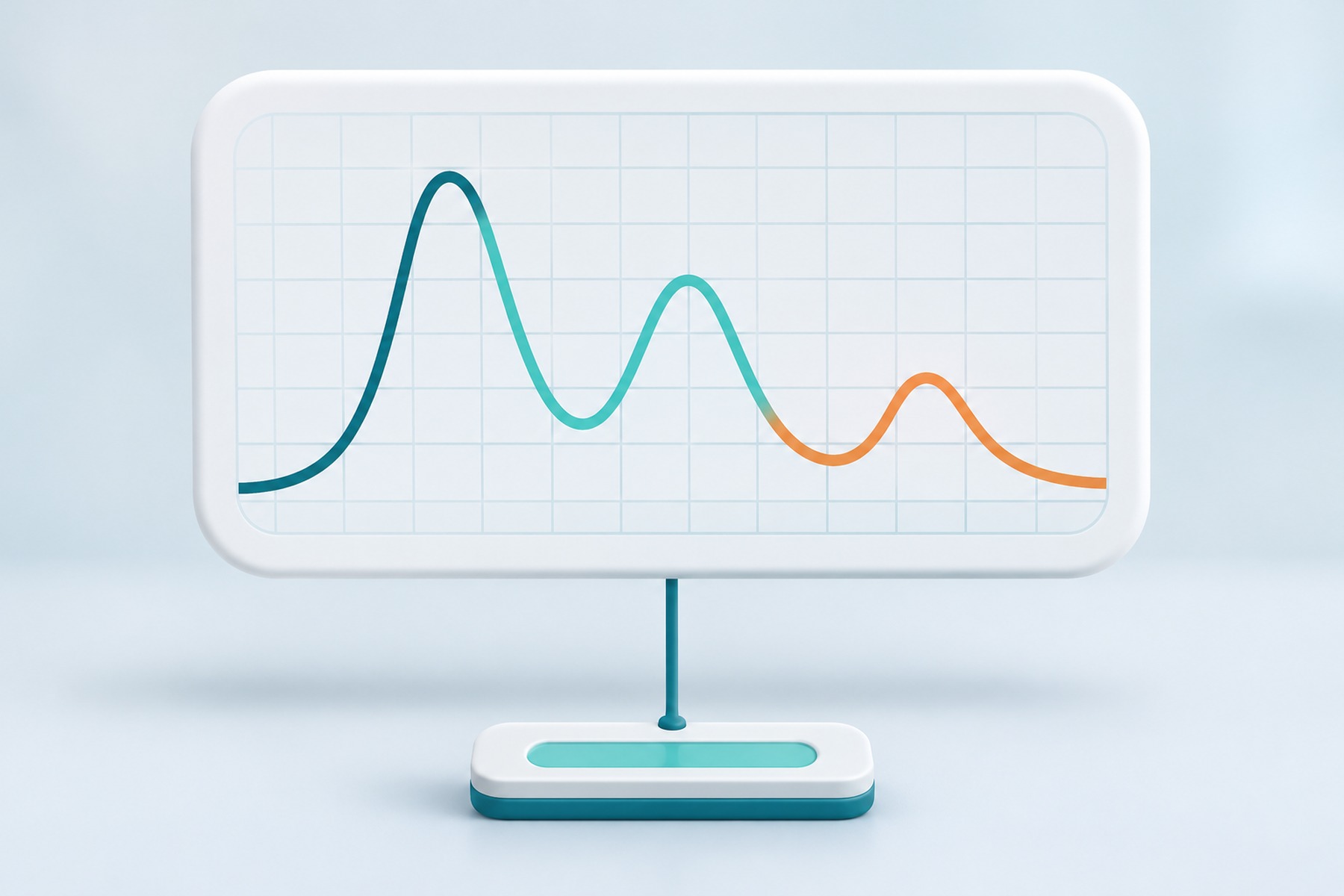
Voltammetry is a family of techniques that "change the voltage and watch how the current responds." When the voltage reaches the level at which a particular substance can react, the current rises to a peak. The result is a graph with voltage on the horizontal axis and current on the vertical axis, called a voltammogram.
There are two rules for reading this graph:
- The position of the peak tells you "which substance it is," because each substance reacts at its own characteristic voltage.
- The size of the peak (its height or area) tells you "how much there is." The more substance, the higher the peak.
The reader compares the peak size with a calibration curve made from solutions of exactly known concentration, then calculates a number, such as micrograms per liter or ppb. (For more on units, see What are ppm and ppb?)
Voltammetry comes in several forms depending on how the voltage is changed. Cyclic voltammetry, which sweeps back and forth, is popular for studying reactions. Differential pulse and square wave voltammetry make peaks sharper and improve detection of small amounts. Heavy metal testing usually uses the latter together with an "accumulation" step, explained next.
Stripping voltammetry: deposit, then strip
Heavy metals in drinking water are usually present in very small amounts. Thailand's Department of Health criteria for drinkable tap water (2020) set arsenic at no more than 0.01 milligrams per liter, or 10 ppb, and cadmium at no more than 0.003 milligrams per liter, or 3 ppb. Measured directly, the signal may be too small to separate from background noise. This is why a technique called stripping voltammetry is used. The form most often used for heavy metals is anodic stripping voltammetry.
The principle is "deposit, then strip," in two stages:
- Deposition stage. A set voltage is held on the working electrode for a while. Metal ions in the water are pulled onto the electrode surface. This is like "scooping the metal out of the whole drop and piling it up in one place." The longer the deposition, the more metal collects on the surface.
- Stripping stage. The voltage is changed gradually. The deposited metals come off as ions again and release current as signal peaks. Each metal comes off at a different voltage, so one measurement gives several peaks.
This deposition step is why an electrochemical sensor can detect metals at microgram-per-liter levels even though the instrument is small. For an overview of this method compared with colorimetric test kits and laboratories, see How many ways are there to test water quality?
Screen-printed electrodes make it portable
In the past, electrochemical measurement needed three separate electrode rods dipped into a beaker, and the electrode surfaces had to be cleaned and polished every time. That suited the laboratory more than the field. The key change was the screen printed electrode, made by printing conductive ink onto a small base so that all three electrodes sit on one strip, much like printing a pattern on a T-shirt with a silkscreen.
Advantages of this type of electrode mentioned in academic reviews include:
- Small and light: it plugs straight into the reader.
- Needs little sample: a drop of sample on the strip is enough to measure.
- Can be mass-produced: each strip has similar properties.
- Surface can be modified: the working electrode can be coated with various materials, including nanomaterials, to capture the target metals better.
What nanomaterials add
Nanomaterials are materials on the scale of a billionth of a meter. When coated onto an electrode surface, they increase the surface area available for metals to attach to, and help the electrode "select" some metals better than others. Heavy metal sensor research around the world therefore often uses screen printed electrodes modified with nanomaterials, together with pulse or square wave stripping voltammetry, to detect several metals at very low levels.
What to know when using an electrochemical sensor to test water
Electrochemical sensors have clear strengths, but like every measuring instrument, they give good results only when the factors that affect them are understood.
| Factor | Why it matters | How it is handled |
|---|---|---|
| Sample acidity (pH) | Reactions at the electrode surface depend on acidity. A review of 23 studies on lead found that measurements were usually made at about pH 3–5.6 | Mix in the sample preparation reagent following the test kit's procedure |
| Organic matter and sediment in water | May coat the electrode surface, making the signal smaller or distorted | Prepare samples as instructed. For very cloudy water, ask about preparation before measuring |
| Other metals with nearby peaks | Signal peaks may overlap, making them harder to separate | Design the electrode and reagents to separate peaks, and calibrate with standards |
| Deposition time | Longer deposition detects lower levels better but takes more time. The same review found deposition was usually 100–400 seconds | Use the value set by the reader's program |
| Calibration and user training | The number depends on the calibration curve and the correct procedure | Follow the manual; users should be trained |
For these reasons, electrochemical field test kits are suited to screening and monitoring. Results that will be used officially, such as in reports or decisions that affect many people, should be confirmed with standard laboratory methods, which use instruments such as ICP-MS and AAS. Read more in What are ICP-MS and AAS?
Electrochemical sensors compared with other methods, briefly
- Compared with colorimetric test kits: colorimetric kits are read by eye from a color, give a range of values, and need no electricity. Electrochemical sensors need a reader but give a number and can detect several metals in one measurement.
- Compared with the laboratory: laboratories are accurate and highly sensitive and are the reference method, but samples must be transported and results take time. Electrochemical sensors give a number at the sampling point and help choose which points should be sent for detailed testing.
Every method has its place, and they complement each other well.
How M-Sense helps
M-Sense is a portable test kit for heavy metal contamination in water that uses an electrochemical technique. It was developed by the National Nanotechnology Center (NANOTEC), NSTDA, under the A-QUALITY program. It tests for four metals: arsenic, lead, cadmium and mercury. It reports results as numbers from ppb to ppm, and a test takes about 5 minutes. It works with a portable reader, so testing can be done at the sampling point.
M-Sense was field-tested with the Regional Environment and Pollution Control Office 1 (Chiang Mai) in the Kok River basin in northern Thailand, compared against standard laboratory methods, and the results were consistent. M-Sense is used for screening and monitoring; suspicious results are still sent for confirmation with standard laboratory methods. See the steps and an interactive simulation on How M-Sense works, and the metals it detects with their criteria on What it detects and the criteria.
Frequently asked questions
How is an electrochemical sensor different from an ordinary sensor? An ordinary sensor may measure a physical quantity such as temperature, light or pressure. An electrochemical sensor measures "chemicals" through reactions on the surface of an electrode, and reads them out as an electrical signal.
Why use three electrodes? Wouldn't two do? Two-electrode systems work for some tasks, but a three-electrode system separates the "voltage reference point" from the "path for the current." This gives more precise control of the voltage at the working electrode, which matters when several metals must be told apart by the position of their signal peaks.
What is a potentiostat? It is the instrument that controls the voltage of the working electrode against the reference electrode and measures the resulting current at the same time. In a field test kit, this circuit sits inside the portable reader.
How is stripping voltammetry different from ordinary voltammetry? Stripping voltammetry adds a step that first "deposits" the metal on the electrode surface and then "strips" it off to measure it. The deposition makes the signal peak large enough to measure very small amounts of metal.
Can an electrochemical sensor replace a laboratory? No. It complements the laboratory. An electrochemical sensor helps with fast screening and monitoring at the sampling point, while the laboratory is the reference method for confirming results and for official reports.
What should I do if a test exceeds the criteria? Send the sample for confirmation with standard laboratory methods, inform the agency responsible for the water source or water supply in the area, and if you are worried about your health, contact a subdistrict health promoting hospital (the local primary care unit) or the local public health office. Information on each metal is in Heavy metals in water: 4 types.
Want to know whether an electrochemical sensor suits your agency's water testing work?
Ask NANOTEC · See how agencies can request it · See field use
References
- Hulanicki A, Glab S, Ingman F. Chemical sensors: definitions and classification. Pure and Applied Chemistry (IUPAC), 1991.
- Elgrishi N, et al. A Practical Beginner's Guide to Cyclic Voltammetry. Journal of Chemical Education, 2018.
- Heller A, Feldman B. Electrochemical glucose sensors and their applications in diabetes management. Chemical Reviews, 2008.
- Fakayode SO, et al. Electrochemical and Colorimetric Nanosensors for Detection of Heavy Metal Ions: A Review. Sensors, 2023.
- Udawaththa N, et al. Advances and opportunities in point-of-care detection of toxic metals: a review of electrochemical and non-electrochemical approaches. Analyst, 2026.
- Jjagwe J, et al. Electrochemical sensors modified with iron oxide nanoparticles/nanocomposites for voltammetric detection of Pb(II) in water: A review. Heliyon, 2024.
- Xie A, Wu W. Emerging nanosensor technologies for the rapid detection of heavy metal contaminants in agricultural soils. Analytical Methods, 2025.
- Public Health Laboratory Division, Department of Health. Criteria for drinkable tap water, Department of Health, 2020 (document SD-RLDC-006). In Thai.
- National Nanotechnology Center. Portable electrochemical test kit innovation for heavy metal contamination in water (M-Sense).
- Krungthep Turakij (Bangkok Biz News). News on the handover of M-Sense to the Chiang Rai Provincial Public Health Office, 15 November 2026. In Thai.