

What Is a Sensor? Biosensors and Nanosensors Explained, With Examples From Water Testing
What is a sensor? In short, it is a device that "recognizes" something we are interested in and "converts" it into a signal that can be measured and read, such as an electrical or light signal. Every sensor therefore has two main parts: a receptor and a transducer. A biosensor is a sensor that uses a biological component, such as an enzyme or an antibody, as its receptor. A nanosensor is a sensor that uses nanoscale materials to help it detect more sensitively. All of these are increasingly used in water quality testing.
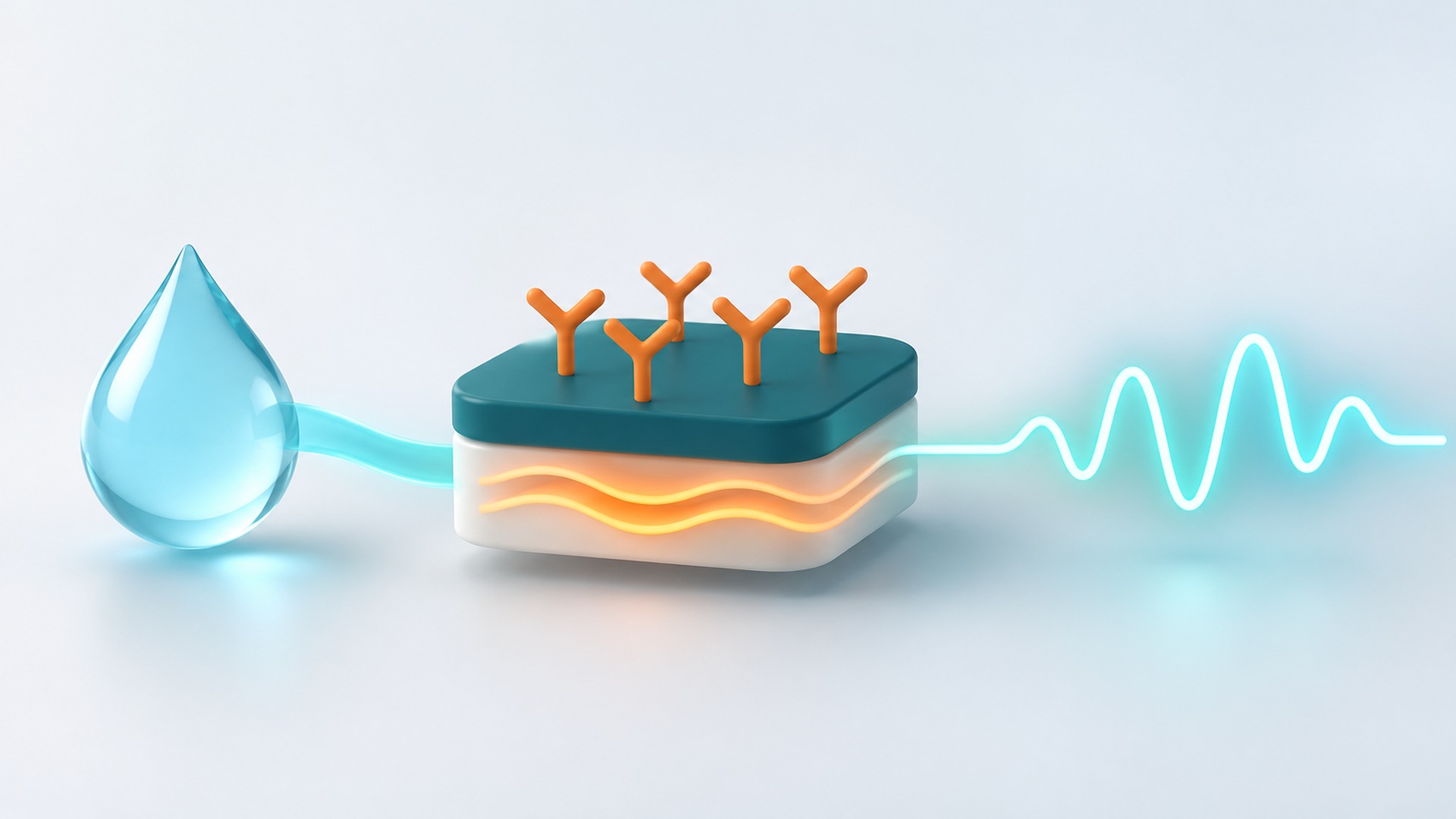
What is a sensor? Two parts that work together
The International Union of Pure and Applied Chemistry (IUPAC), the organization that sets standard terminology in chemistry, explains that a chemical sensor has 2 basic functional parts:
- Receptor: "captures" or "reacts with" the thing to be measured, and converts that information into a form of energy that can be measured. The receptor is the part that lets a sensor "choose" which substance to detect.
- Transducer: converts that energy into a usable signal, such as an electrical current, a voltage or a light intensity. The transducer itself does not choose which substance is measured.
Some sensors also have a thin membrane in between to keep out interference. Once there is a signal, a reader processes it and displays a number or message for people to read.
Think of everyday examples. The probe in a digital thermometer detects heat and converts it into an electrical signal. A pH probe dipped into water detects hydrogen ions and converts them into a voltage. The same principle applies to more complex sensors.
How many types of sensors are there?
Sensors can be classified in many ways. The two easiest views are these.
View 1: By what they detect
| Type | What it detects | Examples in water work |
|---|---|---|
| Physical sensor | Physical quantities such as temperature, light, pressure, level | Temperature probes, turbidity probes (measuring light scattered by particles), water level sensors |
| Chemical sensor | The type and amount of chemicals | pH probes, conductivity probes, electrochemical sensors for heavy metals |
| Biosensor | A target substance, using a biological component as the receptor | Enzyme sensors for pesticides, bacterial cell sensors for arsenic (mostly still in research) |
IUPAC classes biosensors as a subgroup of chemical sensors, because in the end they still measure chemicals; they simply use biological material to do the selective capturing.
View 2: By how the signal is transduced
IUPAC classifies chemical sensors by the principle of the transducer. Groups commonly found in water testing include:
- Optical: measures color change, light absorption or fluorescence.
- Electrochemical: measures the current or voltage produced by reactions on an electrode.
- Electrical: measures changes in electrical properties, such as conductivity.
- Mass-sensitive: measures small changes in mass on the sensor surface.
There are also magnetic and thermal types, but they are less common in field water testing.
Electrochemical sensors, in brief
Electrochemical sensors are widely used for field heavy metal testing because the instruments are small, need little sample, and give numerical results. The general principle is to measure the electrical signal produced by metals in water on a small electrode strip. Each metal gives a signal at a different position, so several can be measured at once. For details on electrodes, the voltage controller and voltammetry, see What is an electrochemical sensor?
What is a biosensor?
Definition
IUPAC defines an electrochemical biosensor as a self-contained device that can provide quantitative or semi-quantitative information, using a biological recognition element held in direct contact with a transducer. Put simply, a biosensor borrows the ability of living things to "recognize" specific substances and uses it for selective capturing, then reads the result with the same kinds of transducers as other sensors.
Types of biological receptors
- Enzymes: proteins that speed up reactions of specific substances, such as the enzyme that converts glucose.
- Antibodies: proteins from the immune system that bind specifically to a target.
- Nucleic acids: DNA or RNA strands designed to bind a target.
- Whole cells: for example, bacteria engineered to give off a light signal when they meet certain substances.
The best-known biosensor
One of the first published biosensors was the enzyme electrode of Leland Clark and Champ Lyons in 1962. This idea was developed into the blood glucose meters many people know. This article does not go into medical detail, but the example shows that biosensors really work in everyday life.
Biosensors in water testing
- Organophosphate pesticides: these chemicals inhibit the enzyme acetylcholinesterase, so research uses this enzyme as the receptor. If the enzyme's activity drops, the water may contain these pesticides. Review articles describe this approach as sensitive, specific, easy to use and fast to respond.
- Arsenic: some research engineers bacteria to give off a fluorescent signal when they meet arsenic. Some studies report detection down to 10 micrograms per liter, which equals the drinking water criterion, but it takes several hours and is still being developed toward portable devices.
Strengths and limitations
Biosensors are often highly specific because biological materials bind substances selectively. But biological materials degrade over time and with temperature, so they must be stored carefully, and living cells need time to respond. IUPAC also recommends distinguishing biosensors from "bioanalytical systems" that need extra reagents added during measurement, and calling devices that can be used only once single-use biosensors.
What is a nanosensor?
What are nanomaterials?
A nanomaterial is a material whose size, or whose internal or surface structure, is in the nanoscale range, which the International Organization for Standardization (ISO) defines as about 1–100 nanometers (1 nanometer is one billionth of a meter). At this size, materials have a large surface area relative to their volume, and some have electrical or optical properties that differ from the same material in bulk.
How nanosensors work
A nanosensor is a sensor in which nanomaterials play a key role, in the receptor, the transducer, or both. A review of nanosensors for heavy metal ions states that nanomaterials increase the surface area of electrodes, so they capture more metal and give clearer signals. They are also used in color-change test kits, for example metal nanoparticles that change color when they meet the target substance.
A nanosensor is not a separate category
A common confusion is that "nano" describes the material used, while "chemical" or "biological" describes the receptor. So one sensor can be several types at once: for example, an electrochemical sensor with a nanomaterial-coated electrode, or a biosensor with an enzyme fixed onto nanoparticles.

Chemical sensor vs biosensor vs nanosensor
| Chemical sensor | Biosensor | Nanosensor | |
|---|---|---|---|
| Receptor | A chemical or material that reacts with the target | Biological material such as enzymes, antibodies, nucleic acids, cells | Can be chemical or biological, but nanomaterials play a key role |
| Strengths | Robust; works well with inorganic substances such as metals | Highly specific | More sensitive thanks to large surface area |
| Cautions | Other substances in water may interfere; needs calibration | Biological material can degrade; needs careful storage | Material production must be kept consistent |
| Examples in water work | pH probes, electrochemical sensors for heavy metals | Enzyme sensors for pesticides, bacterial sensors for arsenic | Nanomaterial-coated electrodes for heavy metals, color-change kits using nanoparticles |
Examples of sensors in water testing
| What you want to know | Commonly used sensor | Status |
|---|---|---|
| Acidity/alkalinity | Chemical sensor (pH probe) | Widely used |
| Overall dissolved minerals | Conductivity probe | Widely used, both portable and installed in systems |
| Turbidity | Optical physical sensor | Widely used |
| Heavy metals such as arsenic, lead | Electrochemical sensors, often aided by nanomaterials | Field kits in real use; results confirmed by laboratory |
| Some groups of pesticides | Enzyme biosensors | Mostly in research and development |
| Arsenic using bacterial cells | Cell-based biosensors | In research |
Whatever the type of sensor, reading results correctly means checking the units. Heavy metal results are usually reported in ppb or micrograms per liter; read more in What are ppm and ppb?, and on choosing a test method in How many ways are there to test water quality?
What kind of sensor is M-Sense?
M-Sense is an electrochemical sensor, not a biosensor. It measures the electrical signal produced by metals in a water sample, and the reader converts it into the concentration of each metal. M-Sense targets heavy metals, which are inorganic substances, so an electrochemical sensor is the principle that fits this job.
How M-Sense helps
M-Sense is a portable test kit for heavy metal contamination in water that uses an electrochemical technique, developed by the National Nanotechnology Center (NANOTEC), NSTDA, under the A-QUALITY program. It tests for four metals: arsenic, lead, cadmium and mercury. It reports results as numbers from ppb to ppm, and a test takes about 5 minutes. It works with a portable reader, so testing can be done at the sampling point.
M-Sense was field-tested with the Regional Environment and Pollution Control Office 1 (Chiang Mai) in the Kok River basin in northern Thailand, compared against standard laboratory methods, and the results were consistent. On 15 November 2026 it was handed over to the Chiang Rai Provincial Public Health Office. M-Sense is used for screening and monitoring; suspicious results are still sent for confirmation with standard laboratory methods. See the principle on How M-Sense works, and read about the developer on About NANOTEC.
Frequently asked questions
What is the difference between a sensor and a meter? The sensor is the part that recognizes and converts the signal. The meter or reader is the part that processes the signal and displays it as a number. One meter may have one sensor or several.
Is a biosensor better than a chemical sensor? Neither is better for every job. Biosensors suit substances that biological materials can bind specifically, such as some groups of pesticides. Chemical sensors are more robust and suit inorganic substances such as heavy metals. Choose according to the substance to be measured and the conditions of use.
Are nanosensors dangerous? In test kits, nanomaterials are usually fixed onto the sensor strip in small amounts. Users should use, store and dispose of sensor strips according to the manual of each test kit.
Is M-Sense a biosensor? No. M-Sense is a test kit that uses an electrochemical technique, measuring the electrical signal from heavy metals in water. It tests for four metals: arsenic, lead, cadmium and mercury.
Are water testing sensors as accurate as a laboratory? Field sensors help with fast screening and monitoring at the sampling point, while the laboratory is the reference method for confirming results and for official reports. The two complement each other. Results above the criteria or suspicious results should be confirmed by a laboratory.
Want to know how an electrochemical sensor can support water monitoring in your area?
Ask NANOTEC · See how M-Sense works
References
- Hulanicki A, Glab S, Ingman F. Chemical sensors: definitions and classification. Pure and Applied Chemistry, 1991.
- Thévenot DR, Toth K, Durst RA, Wilson GS. Electrochemical biosensors: recommended definitions and classification. Biosensors and Bioelectronics, 2001.
- Clark LC, Lyons C. Electrode systems for continuous monitoring in cardiovascular surgery. Annals of the New York Academy of Sciences, 1962.
- Kaur J, Singh PK. Enzyme-based optical biosensors for organophosphate class of pesticide detection. Physical Chemistry Chemical Physics, 2020.
- Elcin E, Öktem HA. Immobilization of fluorescent bacterial bioreporter for arsenic detection. Journal of Environmental Health Science and Engineering, 2020.
- Hu CY, et al. A Portable Arsenic Sensor Integrating with CMOS Technology. ACS Synthetic Biology, 2025.
- International Organization for Standardization. ISO/TS 80004-1 Nanotechnologies — Vocabulary.
- Fakayode SO, et al. Electrochemical and Colorimetric Nanosensors for Detection of Heavy Metal Ions: A Review. Sensors, 2023.
- National Nanotechnology Center. Portable electrochemical test kit innovation for heavy metal contamination in water (M-Sense).
- Krungthep Turakij (Bangkok Biz News). News on the handover of M-Sense to the Chiang Rai Provincial Public Health Office, 15 November 2026. In Thai.