

What Causes Dental Fluorosis? How Much Fluoride in Drinking Water Is Right, and How to Test It
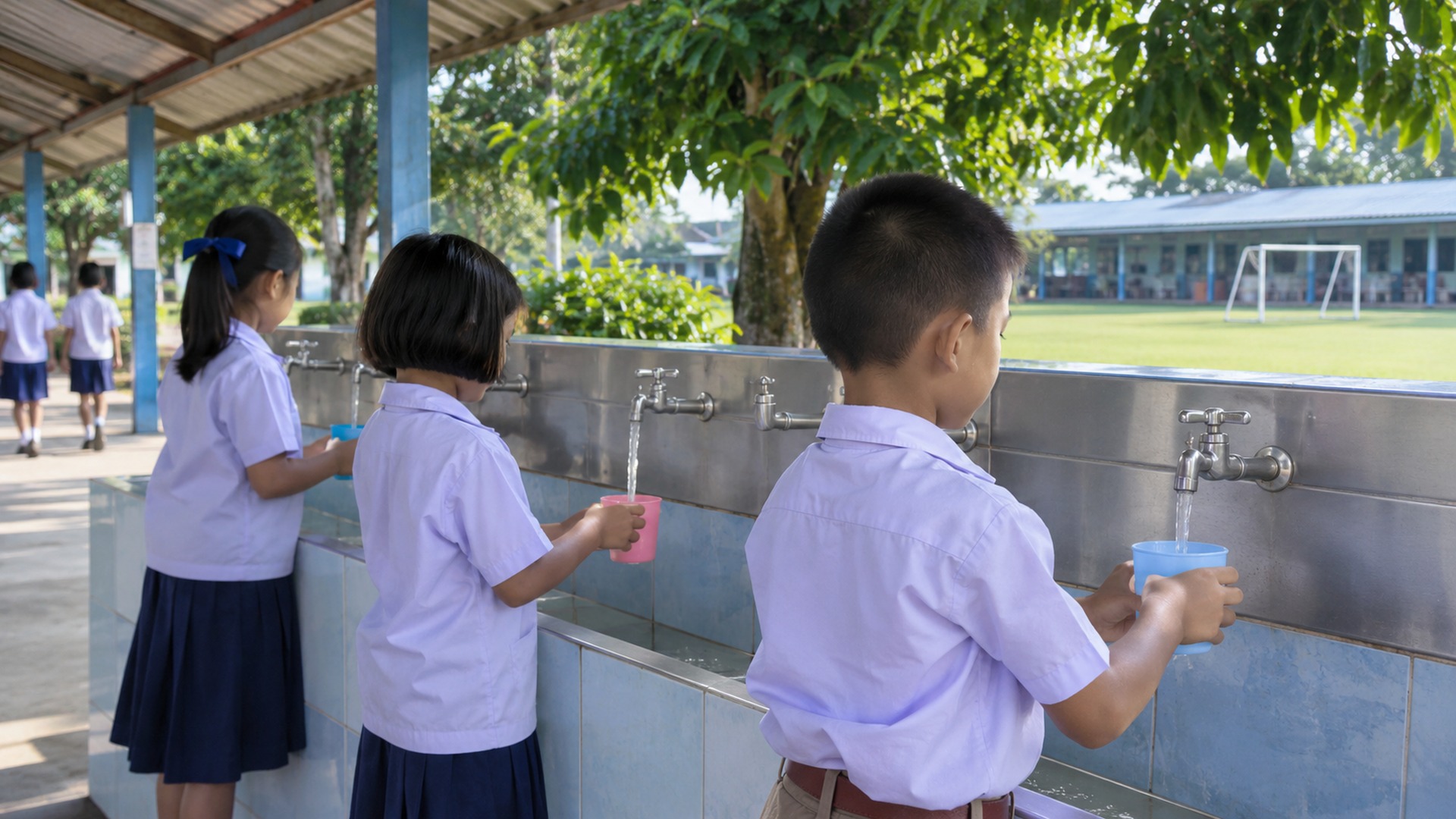
Dental fluorosis is caused by the body taking in too much fluoride while the permanent teeth are still forming under the gums, from infancy to early childhood. In Thailand, an important source is drinking water from groundwater wells in areas with rocks or minerals that are rich in fluoride. Thailand's Department of Health criteria for drinkable tap water (2020) set fluoride at not more than 0.7 mg/L. Water high in fluoride has no color and no smell, so you cannot tell by looking. You only know by testing.
What is dental fluorosis?
Dental fluorosis is a condition in which tooth enamel is not fully mineralized. Documents from the Bureau of Dental Health, part of Thailand's Department of Health, explain that it is caused by too much systemic fluoride (fluoride that is swallowed or drunk). The excess fluoride disrupts the final stage of enamel formation, so protein is left behind and minerals cannot build up fully.
What you see ranges from small opaque white spots or lines on the tooth surface to brown stains and pitted surfaces. The Bureau of Dental Health uses Dean's index, adapted from the World Health Organization oral health survey manual, which divides severity into 6 levels.
| Level | What dental staff find |
|---|---|
| Normal | Smooth, glossy, creamy-white surface |
| Questionable | A few white flecks or spots |
| Very mild | Small opaque white areas covering less than about one quarter of the tooth surface |
| Mild | Larger opaque white areas covering less than about half of the tooth surface |
| Moderate | All tooth surfaces affected, with brown stains and small pits |
| Severe | Tooth shape changes, with stains and pits all over the tooth |
The World Health Organization notes that mild dental fluorosis may not be visible unless examined by a specialist. Assessing the level is therefore the job of a dentist or dental nurse. Do not judge it yourself in the mirror, because stains or white spots on teeth can have many causes.
A document from the Department of Health's International Dental Public Health Center states that dental fluorosis is a permanent condition and cannot be cured. Dentists can help with appearance, for example with tooth whitening, bonding or crowns. The most effective step is therefore prevention before the permanent teeth come in.
Why young children need the most care
Dental fluorosis can only develop while teeth are forming. Once a permanent tooth has finished forming, fluoride taken in later will not cause fluorosis in that tooth. Adults who drink high-fluoride water therefore do not develop new dental fluorosis, but there are bone effects to consider at very high intakes over long periods (see the next section).
This table, adapted from a Bureau of Dental Health document, shows the ages at which each permanent tooth starts to mineralize and finishes forming.
| Permanent tooth | Mineralization starts | Formation complete |
|---|---|---|
| Central incisor | 3–4 months | 4–5 years |
| Canine | 4–5 months | 6–7 years |
| First premolar | 18–24 months | 5–6 years |
| Second premolar | 24–30 months | 6–7 years |
| Second molar | 30–36 months | 7–8 years |
The same document advises dental staff that if fluorosis is found on the permanent front teeth, they should ask where the child lived before age 4; if it is found on the premolars or second molars, they should ask about the period before age 8. This tells us that the water children under about 8 years old drink and that is used to cook their food is where attention matters most for dental fluorosis.
Another point to know is that the risk depends on the total fluoride the body takes in, not only from drinking water. The World Health Organization lists other sources such as food, tea and swallowed fluoride oral care products. The International Dental Public Health Center document also notes that cooking rice and food with high-fluoride water is another route of intake.
How much fluoride in water is right?
Fluoride is not only harmful. The World Health Organization states that low levels of fluoride help prevent tooth decay in both children and adults, and many countries add fluoride to tap water at around 0.5–1 mg/L. The problem is "too much", which usually occurs naturally in groundwater.
This table is summarized from the fluoride chemical fact sheet in the World Health Organization guidelines for drinking-water quality, 4th edition (values are concentrations in drinking water). Actual effects also depend on how much water people drink, for how long, and fluoride from other sources.
| Fluoride in drinking water (mg/L) | What the World Health Organization states |
|---|---|
| About 0.5 and above | Protection against tooth decay begins |
| 0.9–1.2 | Mild dental fluorosis may occur (reported prevalence 12–33%) |
| 1.5 | World Health Organization guideline value; above this, the risk of dental fluorosis increases |
| 3–6 | Changes in bone structure (skeletal fluorosis) may occur, especially when people drink a lot of water |
| Above 10 | Severe, crippling skeletal fluorosis is often found in areas at this level |
Why Thailand's limit is lower than the World Health Organization's
The criteria used to judge drinking tap water in Thailand are the Department of Health criteria for drinkable tap water (2020), which set fluoride at not more than 0.7 mg/L. The figure of 1.5 mg/L is the World Health Organization guideline value, not Thailand's limit.
The World Health Organization itself states that when countries set fluoride standards, they must consider how much water people drink each day and how much fluoride they get from food and other sources. If intake from other sources is high, the standard should be set below 1.5 mg/L. Thailand's lower value follows this principle. When reading drinking water test results in Thailand, always compare them with 0.7 mg/L. Read the other parameters in Thailand's tap water standard (Department of Health, 2020)
A value of 0.7 mg/L equals 0.7 parts per million (ppm). If you are not familiar with these units, read What are ppm and ppb?
Where does fluoride in water come from, and where is it high?
Fluoride is found in rocks and minerals throughout the Earth's crust, such as the mineral fluorite (fluorspar). When groundwater flows through fluoride-bearing rock, fluoride dissolves into it. The International Dental Public Health Center document states that high-fluoride groundwater in Thailand is linked to granite, and may come from geothermal water seeping into groundwater layers along rock fractures. Hot springs therefore often have high fluoride.
The same document states that:
- Thailand has a fluorite mineral belt running from north to south along its western border.
- The provinces the document lists as at risk are Chiang Mai, Chiang Rai, Lamphun, Lampang, Mae Hong Son, Sukhothai, Tak, Uttaradit, Kanchanaburi, Suphan Buri, Ratchaburi, Phetchaburi, Prachuap Khiri Khan and Nakhon Si Thammarat.
- Groundwater data from the Department of Groundwater Resources show wells with fluoride above 0.7 mg/L in many areas.
- Even within one community, fluoride can differ from well to well, depending on how close the well is to fractures in the mineral belt.
A neighbor's well passing a test does not mean yours will pass too. Provinces not on the list may also have high-fluoride wells. The only way to know for sure is to test water from the well you actually use.
How to test for fluoride in water
Fluoride is dissolved in water as an ion. It has no color, no smell and no noticeable taste, so looking at clarity or tasting tells you nothing. The common testing methods are:
| Method | Principle in brief | Where | Best for |
|---|---|---|---|
| Field fluoride test kit (colorimetric) | A reagent is mixed with the water sample; the color changes with the amount of fluoride, then it is compared with a color chart or read with a reader | Wellheads, village water supplies, schools | Screening many points; community monitoring |
| Ion-selective electrode | An electrode that responds specifically to fluoride ions | Laboratory | The common method for measuring fluoride; confirming results |
| Ion chromatography | Separates each type of ion, then measures it | Laboratory | Detailed testing; several ions at once |
The World Health Organization states that the ion-selective electrode method can measure fluoride well below the guideline value, but correct sample preparation is a key step for accurate results. The Department of Health's International Dental Public Health Center uses both field fluoride test kits to train volunteers and community leaders to monitor for themselves, and the electrode method in the laboratory to measure amounts. A Bureau of Dental Health document states that dental staff in hospitals can send water samples to the Bureau of Dental Health laboratory for testing.
For an overview of each water testing method, read Water quality testing methods
Where to take water samples
Bureau of Dental Health guidance recommends taking samples from the water sources people in the community actually use for drinking and cooking. If the community shares a village water supply, 2–3 samples are enough. But if each household uses its own groundwater well, more samples are needed, because each well can be different.
What to do if fluoride is high or children have dental fluorosis
The steps below are summarized from Department of Health documents. They are general guidance, not an individual diagnosis.
- Have dental staff examine the teeth. A dentist or dental nurse at the subdistrict health promoting hospital or local hospital can assess whether it is dental fluorosis and at what level.
- Test the water actually used for drinking and cooking, both at home and at the water sources children used before age 8.
- Choose a low-fluoride water source for drinking and cooking. Options mentioned in Department of Health documents include changing the drinking water source, using rainwater, using bottled drinking water, or using a filter that can reduce fluoride, with priority on the water young children drink.
- Test again after changing the water source or installing a filter, to confirm that fluoride has really been reduced.
- Inform local agencies, such as the local government organization, the subdistrict health promoting hospital or the Provincial Public Health Office, because if it is a village water supply, fixing the system helps the whole community.
The Bureau of Dental Health document states that if fluoride in a drinking water source exceeds 2 ppm (2 mg/L), it should be fixed to prevent future dental health problems. But for deciding whether tap water is "drinkable", the 0.7 mg/L limit still applies.
Which filters reduce fluoride?
Not every filter reduces fluoride. The World Health Organization lists methods used in small systems, such as bone char, contact precipitation, activated alumina and clay. Large systems usually use activated alumina or reverse osmosis. It also notes that in areas with very high natural fluoride, reducing it to the guideline value can be difficult, so water should always be tested after filtering.
Communities that solved the problem
Research by the Department of Health's International Dental Public Health Center followed Mae Pu Kha Subdistrict, San Kamphaeng District, Chiang Mai Province, where groundwater had fluoride above 0.7 mg/L. The community chose to treat its water with a reverse osmosis system, producing water with 0.10 mg/L fluoride. The prevalence of dental fluorosis among sampled students fell from 51.6% in 2011 to 3.8% in 2018. Another area, Dong Chen Subdistrict, Phu Kamyao District, Phayao Province, chose to use rainwater and switched to a low-fluoride surface water source (0.20 mg/L) for its village water supply instead of groundwater wells. The researchers concluded that a key factor was that the communities chose the solution themselves.
Fluoride in water and other health effects
Exposure to fluoride does not mean you will get sick. Effects depend on the total amount taken in and the length of exposure. At the levels commonly found in Thai groundwater, the clearest effect is dental fluorosis in children. For bone effects, the World Health Organization states that they occur when drinking water has around 3–6 mg/L of fluoride or more, and severe forms are usually found above 10 mg/L. The World Health Organization also concludes that the available evidence does not support fluoride in drinking water causing cancer in humans, although data on bone cancer are still limited.
If you are worried about the health of people in your household, consult your subdistrict health promoting hospital, a local hospital, or the Department of Health hotline at 1478. Do not stop using fluoride toothpaste on your own out of fear of dental fluorosis, because fluoride toothpaste is a way of preventing tooth decay accepted by the World Health Organization. Ask dental staff how much children of each age should use.
How M-Sense can help
To be clear: M-Sense does not test fluoride. M-Sense is a portable heavy metal test kit for water from the National Nanotechnology Center (NANOTEC), part of Thailand's National Science and Technology Development Agency (NSTDA). It tests 4 metals, arsenic, lead, cadmium and mercury, in about 5 minutes and reports results as numbers from ppb to ppm. To test fluoride, use a field fluoride test kit or send samples to a laboratory, as in the table above. NANOTEC has another test kit for chemicals in water, called ChemSense, that can test fluoride. Ask for details through the Ask NANOTEC button.
The role of M-Sense here is testing alongside. The same groundwater well may contain both fluoride and heavy metals such as arsenic. These are different groups of substances that need different tools. Agencies surveying groundwater in an area can therefore use M-Sense to screen for the 4 heavy metals at the sampling point in the same round as fluoride testing. Results that exceed the criteria should be confirmed with standard laboratory methods. See what it detects on the What it detects and the limits page.
Frequently asked questions
What causes dental fluorosis? Taking in too much fluoride while the permanent teeth are forming, from infancy to about age 8. The main source is drinking and cooking water high in fluoride, especially groundwater in some areas.
Can dental fluorosis be cured? Department of Health documents state that it is a permanent condition and cannot be cured. Dentists can help with appearance, for example with whitening, bonding or crowns. Consult a dentist to choose the right option for each person.
Will adults get dental fluorosis from drinking high-fluoride water? No new dental fluorosis develops, because the permanent teeth have finished forming. But very high fluoride intake over a long time can affect bones, according to the World Health Organization, so the whole household should use water that meets the criteria.
What is Thailand's limit for fluoride in drinking water? The Department of Health criteria for drinkable tap water (2020) set it at not more than 0.7 mg/L. The figure of 1.5 mg/L is the World Health Organization guideline value.
If water is clear and odorless, does that mean it has no fluoride? No. Water high in fluoride has no color and no smell, so you cannot tell by looking. It must be tested with a fluoride test kit or in a laboratory.
Can M-Sense test fluoride? No. M-Sense tests 4 heavy metals: arsenic, lead, cadmium and mercury. Fluoride needs a fluoride test kit or a laboratory.
Want to plan groundwater testing in your area?
Ask NANOTEC · What it detects and the limits · Field use
References
- Division of Public Health Laboratory, Department of Health. Department of Health criteria for drinkable tap water, 2020 (document SD-RLDC-006, effective 28 April 2023).
- World Health Organization. Guidelines for drinking-water quality, 4th edition incorporating the first and second addenda, 2022 (Chemical fact sheets: Fluoride).
- Bureau of Dental Health, Department of Health, Thailand. Guidelines for managing high fluoride when dental fluorosis is found in an area, to prevent dental health problems, 2023.
- International Dental Public Health Center, Department of Health, Thailand. Knowledge from the surveillance system: applying geographic information to solve fluoride problems in drinking water (Fluoride Mapping).
- International Dental Public Health Center, Department of Health, Thailand. Fluoride in drinking water, dental fluorosis and community solutions.
- National Nanotechnology Center. Portable electrochemical test kit for heavy metal contamination in water (M-Sense).
- ThaiPR.net. NSTDA news on a plan to develop test kit standards with the Department of Science Service, 18 March 2026.