

What Is Biochar? How It Differs from Activated Carbon, and How Well It Removes Arsenic from Water
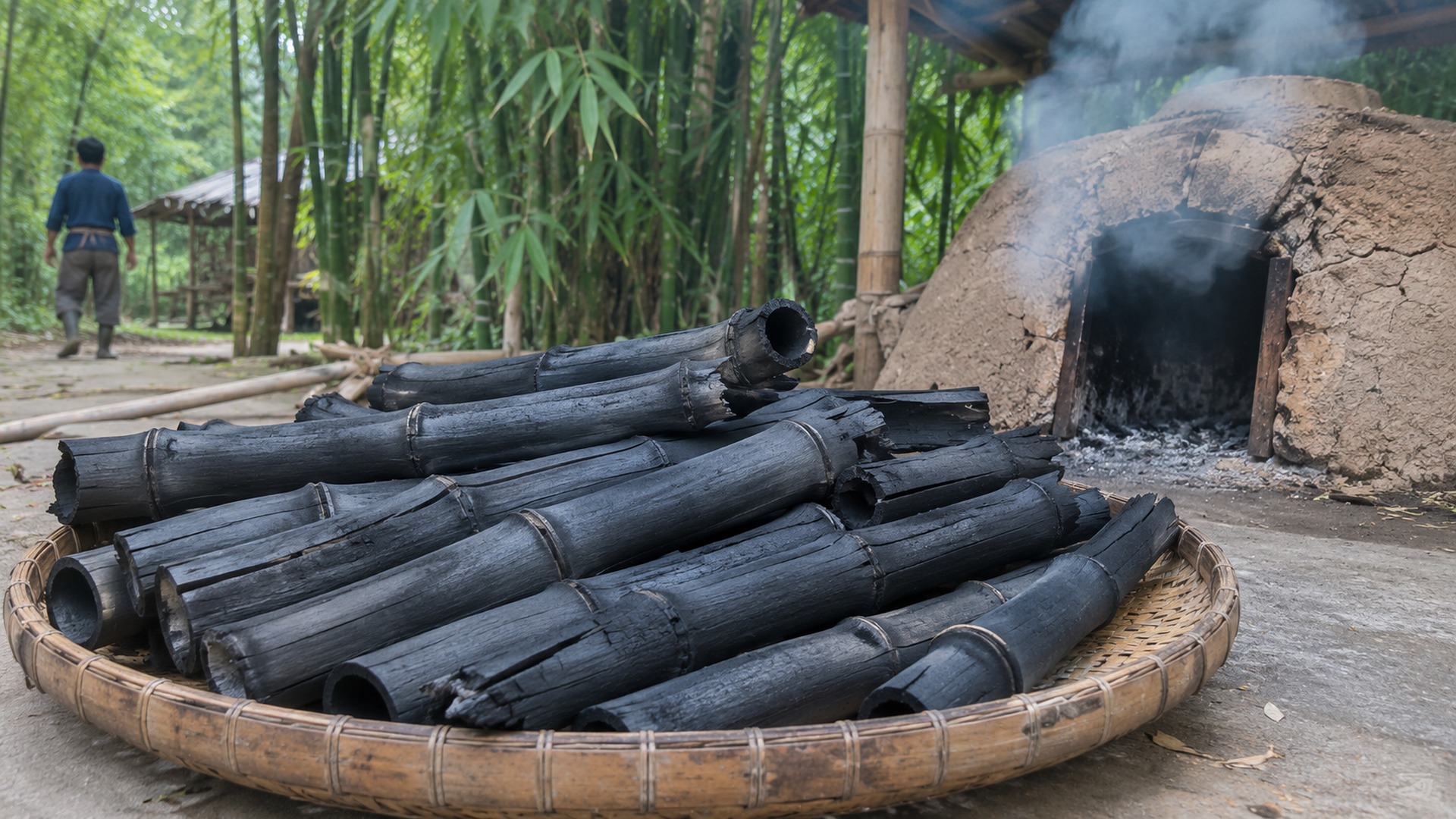
Biochar is a carbon-rich solid made by heating biomass, such as wood, bamboo, or fruit shells and husks, with no oxygen or very little oxygen. Activated carbon is charcoal that goes through an extra "activation" step to give it more pores so it can adsorb more substances. Both can adsorb substances from water, but plain charcoal traps little arsenic. It needs surface modification first to work well, and water must always be tested after filtering.
What is biochar?
The International Biochar Initiative defines biochar as a solid material obtained from the thermochemical conversion of biomass in an oxygen-limited environment. A 2024 glossary from the International Union of Pure and Applied Chemistry (IUPAC) describes it as a carbon-rich solid produced by pyrolysis (breaking down by heat with no or little oxygen) at about 300–800 °C.
Put simply, biochar is "charcoal" made from biological material. The Thai term for "bio-charcoal" usually means the same thing. Many raw materials can be used, such as wood waste, bamboo, rice husks, corn cobs, coconut shells and macadamia shells. The type of raw material and the burning temperature affect the properties of the charcoal, such as porosity and surface charge.
Biochar in agriculture
Most people searching for biochar are interested in soil. The IUPAC glossary notes that most biochar research focuses on adding it to soil. A review in the journal Bioresource Technology (2017) concluded that besides improving soil and storing carbon, biochar is attracting interest as an adsorbent for contaminants in water. This article focuses on water. For using biochar in fields, consult local agricultural agencies, because results depend on the type of soil and the type of charcoal.
What is activated carbon?
IUPAC describes activated carbon as a porous carbon material: charcoal that has been reacted with gases, sometimes with added chemicals, to increase its adsorption capacity, and used to purify liquids and gases. This step is called activation. It gives the charcoal a large number of tiny pores, so its internal surface area increases. It is also sometimes called "activated charcoal".
Activated carbon has long been used in water treatment, for example in drinking water filters to reduce odor and organic substances. Thailand's Department of Health advises that if you do not like the smell of chlorine in tap water, you can let the water stand in a container or filter it with activated carbon. Read more in Is tap water safe to drink?
Biochar vs activated carbon: what is the difference?
Both start as charcoal. The main differences are the steps after burning and the purpose of production.
| Topic | Biochar | Activated carbon |
|---|---|---|
| Raw material | Biomass such as wood, bamboo, rice husks, shells | Carbon-containing materials, including biomass |
| Production | Heated in an oxygen-limited environment | Turned into charcoal, then activated with gas, or gas together with chemicals |
| Pores and adsorption | Porous, but generally less than activated carbon | Designed to be highly porous, with high adsorption |
| Main uses | Soil improvement, carbon storage, and research on adsorbents | Purifying water and gases; reducing odor, color and organic substances |
| Production cost | Reviews report it is lower, because it needs no activation or less activation | Higher, because of the activation step |
A review in the journal Environment International (2019) states that biochar is seen as an alternative to activated carbon because its production and activation costs are lower. A review in Bioresource Technology (2017) that assessed the whole life cycle of the materials reported that producing biochar has a smaller overall environmental impact than using conventional activated carbon.
The line between the two terms is not fixed. Biochar that is surface-modified or further activated becomes more like activated carbon, so research papers often use terms such as "modified biochar" or "surface-modified biochar".
How does charcoal trap substances in water?
Adsorption is the process by which molecules or ions in water attach to the surface of a material. The more surface area a material has, and the more chemical groups on its surface that can "grab" the target substance, the more it can trap.
Reviews of biochar and arsenic summarize several main mechanisms, such as:
- Surface complexation: arsenic binds to chemical groups or metals on the charcoal surface.
- Electrostatic attraction: positively charged surfaces attract negatively charged arsenic ions.
- Ion exchange: ions on the charcoal surface are replaced by arsenic ions.
- Surface precipitation: arsenic reacts and settles as a solid on the material.
How well does a biochar water filter remove arsenic?
The short answer: plain charcoal does not trap much arsenic; it needs surface modification first. A review in the journal Environmental Geochemistry and Health (2023) explains that unmodified biochar usually adsorbs arsenic fairly poorly, because most charcoal surfaces are negatively charged, while arsenic in water is usually also in negative ion form, so they repel each other. Researchers have therefore developed ways to modify the charcoal surface, and iron modification is the most widely used method because it is low cost and works well.
This table summarizes factors that several literature reviews identify as affecting arsenic removal.
| Factor | Effect on arsenic removal | Source |
|---|---|---|
| Surface modification | Biochar that is surface-modified or pre-loaded with metals traps more than plain biochar | 2023 review · 2023 meta-analysis |
| Type of arsenic | On average, pentavalent arsenic (As(V)) is trapped better than trivalent arsenic (As(III)) | 2023 meta-analysis |
| Surface charge of the material | A more positively charged surface improves removal | 2023 meta-analysis |
| pH of the water | A main factor limiting efficiency | 2021 review |
| Phosphate in the water | Phosphate has a structure similar to pentavalent arsenic and competes for binding sites on the material | 2021 review |
Limitations to know
- Moving from the lab to the field is still a big task. The review in Environment International (2019) states that scaling arsenic-removing charcoal from the laboratory to the field is an urgent next step. Figures obtained in the lab do not mean the same results for every water source.
- Adsorbents become saturated. When the surface of the material is fully occupied, it can no longer trap arsenic. The material must be replaced or regenerated, and water must be tested after filtering from time to time to know when replacement is due.
- Used material must be disposed of safely. A meta-analysis in the journal Science of the Total Environment (2023) recommends that future research focus on reusing materials and safely disposing of the arsenic they have trapped.
- Untreated biomass has its own problems. A review in the Journal of Environmental Management (2020) states that untreated biomass usually adsorbs poorly, is brittle and may color the water.
NANOTEC's work: local biochar to remove arsenic in village water supplies
The National Nanotechnology Center (NANOTEC), part of Thailand's National Science and Technology Development Agency (NSTDA), has developed arsenic-trapping filter materials from local resources. According to NANOTEC's reports:
- Raw materials: bamboo charcoal and macadamia shells.
- Surface modification: with wood vinegar (a by-product of charcoal making).
- Result: up to 89% arsenic removal, at a lower cost than commercial materials.
- Use: filter tanks filled with surface-modified biochar, added to existing water supply systems together with low-energy sedimentation tanks, with an upgrade budget of 13–26% of building a new system.
A field example is Ban Rim Kok, Mae Yao Subdistrict, Mueang Chiang Rai District, northern Thailand. Arsenic in the raw water fell from 0.069 mg/L to 0.0035 mg/L at the water tower after the upgraded system (this figure is the result of the whole system, not the charcoal alone). That is below Thailand's Department of Health criteria for drinkable tap water (2020), which set arsenic at not more than 0.01 mg/L.
This approach matches what the literature reviews suggest: use low-cost biomass available locally, then modify the surface to trap arsenic better. NANOTEC's principle for working with communities is "researchers as mentors, communities as owners, and local government as supporters". Read more about NANOTEC on the About NANOTEC page.
Besides biochar, NANOTEC also chooses other technologies based on each area's water test results, such as sedimentation, filtration, adsorption with activated carbon, and membrane filtration. Each method suits different problems, so water must be tested first before choosing a treatment method.
Can you use charcoal to filter water at home?
Charcoal from a stove or ordinary charcoal you buy is not designed to trap arsenic. The reviews cited above show that plain biochar traps arsenic fairly poorly. Putting charcoal in a jar or filter bucket yourself should therefore not be considered a way to make water safe from arsenic. The research compiled for this website also found that ordinary household filters may not reduce arsenic to a safe level.
If the water you use may contain arsenic, what you should do is:
- Test the water first, to know how much arsenic or other heavy metals it contains.
- Choose a treatment method certified to actually reduce that substance.
- Test the water after filtering to confirm the result, and retest from time to time.
- If you have health concerns, consult your subdistrict health promoting hospital or local public health office.
Exposure to arsenic and getting sick are two different things. Effects depend on the amount and the length of exposure. Read more in What is arsenic? and Heavy metals in water
How M-Sense can help
You only know whether an arsenic-trapping filter material works by testing the water both before and after filtering. M-Sense is a portable heavy metal test kit for water from NANOTEC. It tests arsenic, lead, cadmium and mercury in about 5 minutes and reports results as numbers from ppb to ppm. It can be used with surface water, groundwater and community water for drinking and household use.
For water supply operators who use adsorbents, M-Sense helps screen arsenic in raw water and in water after the filter tank on site, showing the trend of whether the material is starting to saturate. Results that exceed the criteria, or results needed for official use, should be confirmed with standard laboratory methods. See what it detects in What it detects and the limits and examples of use in Field use
Frequently asked questions
What is biochar? Biochar, or bio-charcoal, is a carbon-rich solid made by heating biomass such as wood, bamboo, rice husks or shells with no oxygen or very little oxygen.
What is activated carbon? Activated carbon is charcoal that has been activated with gas, sometimes together with chemicals, to give it more pores so it can adsorb more. It is used to clean water and air, for example to reduce chlorine odor and organic substances.
Which is better, biochar or activated carbon? It depends on the job. Activated carbon adsorbs well and has long been used in water treatment. Biochar costs less to produce and can use local raw materials. For arsenic, both usually need surface modification to trap it well.
Does bamboo charcoal really remove arsenic? Plain bamboo charcoal traps little. NANOTEC's work uses bamboo charcoal and macadamia shells surface-modified with wood vinegar, which removed up to 89% of arsenic, together with a sedimentation system in village water supplies.
Can biochar be added to soil? Yes. Biochar can be used to improve soil, and this is the use with the most research, but results depend on the type of soil and charcoal. Consult local agricultural agencies.
How often should arsenic filter material be replaced? There is no single number that works everywhere, because it depends on the amount of arsenic, the volume of water and other substances in the water. The practical way is to test water after filtering from time to time. If arsenic levels start to rise, the material is close to saturation.
Want to know which method suits the water supply in your area?
Ask NANOTEC · About NANOTEC · For agencies
References
- International Biochar Initiative. Definition of biochar (About page).
- Bilias F, et al. Glossary of terms used in biochar research (IUPAC Technical Report). Pure and Applied Chemistry, 2024.
- IUPAC. Compendium of Chemical Terminology (Gold Book): activated carbon.
- Moreira MT, Noya I, Feijoo G. The prospective use of biochar as adsorption matrix – A review from a lifecycle perspective. Bioresource Technology 2017;246:135–141.
- Alkurdi SSA, et al. Biochar versus bone char for a sustainable inorganic arsenic mitigation in water: What needs to be done in future research? Environment International 2019;127:52–69.
- Tian L, et al. Biochar modification to enhance arsenic removal from water: a review. Environmental Geochemistry and Health 2023;45(6):2763–2778.
- Aktar S, et al. Arsenic removal from aqueous solution: A comprehensive synthesis with meta-data. Science of the Total Environment 2023;862:160821.
- Weerasundara L, Ok YS, Bundschuh J. Selective removal of arsenic in water: A critical review. Environmental Pollution 2021;268:115668.
- Zoroufchi Benis K, et al. Treatment of aqueous arsenic – A review of biosorbent preparation methods. Journal of Environmental Management 2020;273:111126.
- Srivastav AL, et al. Biochar adsorbents for arsenic removal from water environment: A review. Bulletin of Environmental Contamination and Toxicology 2022;108(4):616–628.
- Division of Public Health Laboratory, Department of Health. Department of Health criteria for drinkable tap water, 2020.
- National Nanotechnology Center. Arsenic management innovation for sustainable clean tap water production (A-QUALITY Community Water Clinic).
- National Nanotechnology Center. Report on the use of technology to solve water quality problems and improve community access to clean water.
- National Nanotechnology Center. Portable electrochemical test kit for heavy metal contamination in water (M-Sense).